
Newentor Weather Station Wireless Indoor Outdoor Thermometer
4.3Editor score
Large color LCD display
Wireless remote sensor support
Atomic time and date
This guide compares the best large screen weather stations for home use, evaluating display quality, sensor accuracy, and smart features to help you choose.
Finding a reliable weather monitoring tool starts with a clear, large display that shows essential data at a glance. Modern stations offer colorful screens, wireless sensors, and detailed forecasts to keep you informed about indoor and outdoor conditions throughout the day.
We evaluated ten top-rated models based on screen size, data accuracy, wireless range, and ease of setup. Our comparison includes budget-friendly options and advanced smart stations with Wi-Fi connectivity, ensuring you find a unit that matches your specific home monitoring needs.
Each pick below highlights key strengths, trade-offs, and ideal user scenarios to guide your decision. Please note that availability and pricing may change over time, so verify current details on the product pages before making your final purchase choice.
4.3Editor score

4.4Editor score

4.1Editor score
The following side-by-side comparison highlights the core specifications and capabilities of each model to help you quickly identify which large screen weather station best fits your monitoring requirements.


The Newentor Weather Station delivers a robust entry-level experience with a large color LCD that presents essential indoor and outdoor metrics clearly. With a solid user rating, it stands out for combining atomic timekeeping with reliable weather forecasting in a compact footprint suitable for any room.
We may earn a commission when you buy through this link, at no additional cost to you.
Its wireless capability supports up to three remote sensors, allowing you to monitor temperature and humidity across multiple zones. The display shows daily high and low records, customizable alerts, and a moon phase indicator, making it versatile for daily planning and long-term tracking.
While it includes only one remote sensor in the package, the expandability is a strong point for budget-conscious buyers. The eco-energy-saving mode dims the screen when on battery power, which helps extend battery life though it may limit always-on visibility compared to plugged-in models.
This model is ideal for homeowners who want a clear, colorful display without investing in advanced smart features. It balances functionality and cost effectively, making it a recommended starting point for those new to wireless weather monitoring systems.
The color LCD ensures all critical data like temperature and forecasts are visible at a glance without needing to press buttons or adjust settings.
You can choose between constant wall power for an always-on display or battery power with an automatic dimming feature to conserve energy.
We may earn a commission when you buy through this link, at no additional cost to you.
The AcuRite Iris offers an extensive suite of weather data that appeals to enthusiasts who want more than just temperature and humidity readings. Its high rating reflects user satisfaction with the clarity of its color display and the depth of information it provides for daily decision making.
We may earn a commission when you buy through this link, at no additional cost to you.
You receive readings for wind speed, direction, barometric pressure, and rainfall directly to the indoor console. The system also calculates heat index, dew point, and feels like temperature, giving a complete picture of outdoor comfort and safety conditions in real time.
Setup is straightforward, requiring only battery installation and mounting the outdoor sensor on a pole. However, the need for external mounting might be a consideration for renters or those without easy access to an exterior post near the station.
This unit is best for users who prioritize detailed historical data and personalized forecasts over simplicity. Its ability to show pressure trends with arrows helps anticipate weather changes before they occur, making it a valuable tool for proactive planning.
With over 55 data points available, you can track detailed trends like dew point and heat index to understand true outdoor comfort levels.
Pressure trends displayed with arrows allow you to see weather patterns developing over time without needing complex interpretation.
We may earn a commission when you buy through this link, at no additional cost to you.
La Crosse Technology brings decades of experience to this model, offering dynamic forecast icons and detailed comfort charts that are easy to interpret. The large display highlights indoor and outdoor conditions clearly, making it a practical choice for households that value straightforward weather information.
We may earn a commission when you buy through this link, at no additional cost to you.
Its alert system allows you to set custom high and low limits for temperature and humidity, ensuring you are notified of potentially uncomfortable or risky conditions. The atomic clock keeps accurate time and adjusts automatically for daylight savings, reducing manual intervention.
When running on batteries, the backlight only illuminates temporarily to save power, which might inconvenience users who prefer a permanently lit display. Additionally, barometric calibration requires a few days to reach peak accuracy, so patience is needed after initial setup.
This station suits families or individuals who want a dependable, visually appealing monitor without smart home complexity. The combination of alerts, comfort visuals, and accurate timekeeping makes it a solid all-rounder for everyday use.
Colorful bars display humidity levels for both indoor and outdoor environments, helping you quickly gauge comfort without reading raw numbers.
With seven time zone settings and automatic daylight savings adjustments, this clock adapts easily to travel or relocation needs.
We may earn a commission when you buy through this link, at no additional cost to you.
The Ambient Weather WS-5000 stands out for its ultrasonic sensor array that eliminates moving parts, ensuring durability and consistent performance over time. Its premium status is justified by real-time updates every five seconds and a suite of smart home integrations that extend its utility beyond basic monitoring.
We may earn a commission when you buy through this link, at no additional cost to you.
You can set up alerts and access data remotely via Wi-Fi, integrating seamlessly with platforms like Alexa and Google Home. This connectivity allows you to automate home functions based on weather conditions, such as adjusting thermostats or irrigation systems automatically.
The initial setup may be more involved compared to simple battery-powered units, requiring network configuration and sensor calibration. Additionally, the higher price point places it out of reach for casual users, but it offers significant value for tech-savvy homeowners.
Ideal for those seeking cutting-edge technology and community-driven weather insights, this station delivers a modern experience. Its ability to join the personal weather station network provides hyperlocal data that can benefit neighbors and the broader weather community.
Integration with platforms like IFTTT and Alexa lets you automate home systems based on real-time weather data from your backyard.
Connect to the Ambient Weather Network to share your data and create custom forecasts, contributing to a larger global weather picture.
We may earn a commission when you buy through this link, at no additional cost to you.
The WS-2000 features a wireless all-in-one integrated sensor array that simplifies installation by reducing the number of external components needed. With a TFT color display on the console, you get clear visuals of wind speed, direction, rainfall, and UV radiation directly on your tabletop unit.
We may earn a commission when you buy through this link, at no additional cost to you.
Enhanced Wi-Fi connectivity allows you to transmit data to the world's largest personal weather station network, enabling remote monitoring and data sharing. This feature is particularly useful for users who want to track weather trends over time or share data with local weather groups.
The sensor array requires three AAA batteries, meaning it depends on battery life rather than a hardwired power source. While this aids flexibility in placement, it introduces maintenance needs for battery replacements to ensure uninterrupted data collection.
This model fits well for homeowners seeking a balance between advanced features and ease of use. Its ability to support both imperial and metric units with calibration options ensures it meets diverse regional and personal preferences.
The all-in-one sensor array reduces clutter and setup time, making it easier to deploy without managing multiple disconnected units.
Wi-Fi connectivity lets you monitor your weather station from anywhere, giving you constant access to conditions no matter where you are.
We may earn a commission when you buy through this link, at no additional cost to you.
La Crosse delivers a strong traditional weather station with a focus on reliability and extended wireless range. The full-color LCD provides dynamic forecast icons and tendency indicators, while the 300-foot transmission range ensures consistent data even from distant outdoor sensors.
We may earn a commission when you buy through this link, at no additional cost to you.
You can set customizable alerts for temperature and humidity thresholds, making it easier to monitor sensitive areas like greenhouses or basements. The atomic self-set time and calendar function keep your schedule accurate without manual adjustments for daylight savings time changes.
The adjustable backlight intensity offers flexibility for different lighting conditions, though the battery-operated mode only illuminates the display on demand to conserve power. This might be inconvenient for those who prefer a constantly lit clock or display in low-light environments.
This unit is perfect for users who need a dependable, non-smart solution with long-range capabilities. Its robust sensor design and clear visual feedback make it a trusted choice for monitoring home conditions effectively.
With a transmission range of up to 300 feet, you can place sensors in remote parts of your yard without signal loss.
Set personalized high and low limits for temperature and humidity to receive notifications when conditions exceed your preferred thresholds.
We may earn a commission when you buy through this link, at no additional cost to you.
Tempest combines advanced engineering with environmental efficiency by using a solar-powered outdoor sensor that requires minimal maintenance. Trusted by leading experts and thousands of users, it delivers hyperlocal weather forecasts through a wireless connection that supports app and Alexa integration.
We may earn a commission when you buy through this link, at no additional cost to you.
It monitors a wide range of metrics including lightning strikes, UV index, and rainfall, all from a single durable device. The lack of moving parts enhances reliability, ensuring consistent performance even in harsh weather conditions over years of use.
While solar power is a major advantage, it depends on sufficient sunlight exposure to function optimally, which could be a limitation in shaded areas. The investment cost is also higher than basic stations, reflecting its advanced features and robust build quality.
This station is best for tech-oriented users who want reliable, low-maintenance monitoring with smart home capabilities. Its ability to automate home functions based on weather data makes it a valuable asset for modern home management.
Engineered with no moving parts, the Tempest sensor is built to withstand harsh conditions and reduce long-term maintenance needs.
Seamlessly connects with Alexa and Rachio to automate irrigation and other home systems based on real-time weather conditions.
We may earn a commission when you buy through this link, at no additional cost to you.
The S84107 adds a decorative touch with seasonal foliage backgrounds that change every three months, making it a stylish addition to any room. Despite its compact size, it offers a dynamic color forecast display and barometric pressure graphs that help visualize weather trends over time.
We may earn a commission when you buy through this link, at no additional cost to you.
It tracks indoor and outdoor temperature, humidity, and historical graphs for the last 24 hours. The inclusion of atomic time ensures your clock remains accurate without manual adjustments, while customizable alerts notify you of significant changes.
Its sensor capabilities are more limited compared to advanced models, with no Wi-Fi or multi-sensor expansion options available. This makes it best suited for users who prioritize aesthetics and basic monitoring over extensive data collection.
Ideal for households seeking a visually appealing weather monitor, this unit blends function with design. Its straightforward interface and clear display make it accessible for users of all ages and technical skill levels.
Backgrounds change with the seasons, adding a touch of natural beauty that refreshes your display throughout the year.
View past weather patterns with a 24-hour historical graph, helping you understand recent trends at a glance.
We may earn a commission when you buy through this link, at no additional cost to you.
This professional model offers remote monitoring via Wi-Fi, allowing you to track weather conditions from anywhere using a mobile app. With a transmission range of up to 400 feet, it ensures reliable connectivity even with sensors placed far from the main console.
We may earn a commission when you buy through this link, at no additional cost to you.
It includes dedicated wind and rain gauges, providing precise data on speed, direction, and rainfall amounts. Enhanced connectivity also unlocks AccuWeather data streaming, giving you access to broader forecasts and local weather insights beyond raw sensor readings.
Setup requires connecting to your home Wi-Fi network and installing multiple batteries for outdoor sensors, which might take more time than basic models. However, the investment pays off in the flexibility of remote access and detailed environmental tracking.
Best for users who need accurate data from a distance, this station supports remote management and notifications. Its comprehensive feature set makes it suitable for both hobbyists and those who rely on weather information for outdoor activities.
Track your home weather from anywhere with the free mobile app, ensuring you stay updated no matter your location.
AccuWeather data streaming provides extended forecast options and local insights that go beyond standard sensor readings.
We may earn a commission when you buy through this link, at no additional cost to you.
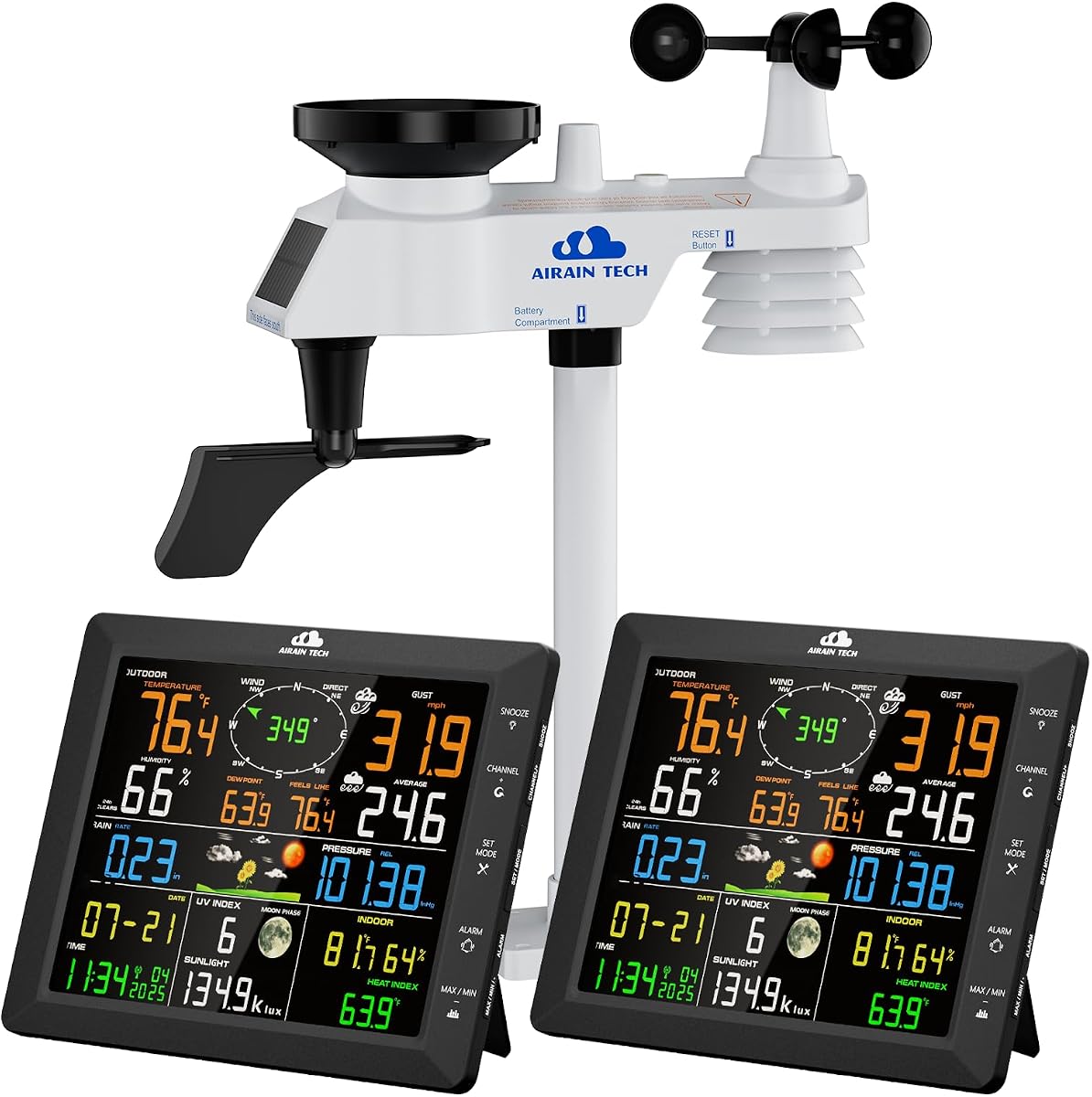
This station features an 8.5-inch large screen that ensures all weather data is visible from across the room. With dual display units included, you can place monitors in different locations while maintaining synchronized data across your home.
We may earn a commission when you buy through this link, at no additional cost to you.
It utilizes high-precision Swiss sensors for temperature and humidity, offering accuracy suitable for environmental monitoring and research needs. The outdoor sensor provides a wide transmission radius of 328 feet, ensuring stable connectivity without the need for complex wiring.
While it lacks Wi-Fi connectivity, the focus remains on precise local data and ease of use. The minimalist installation process allows for quick setup with adjustable mounting brackets, making it accessible even for those with limited technical experience.
Ideal for households prioritizing screen size and data precision, this station delivers reliability without smart complexity. It serves well for families, educators, or hobbyists who want clear, accurate weather tracking in multiple indoor locations.
With two display units included, you can monitor weather conditions from multiple rooms without losing data synchronization.
High-precision sensors provide reliable hydro-meteorological data suitable for both home use and educational purposes.
We may earn a commission when you buy through this link, at no additional cost to you.
Selecting the right large screen weather station involves balancing display size, sensor accuracy, connectivity options, and overall value to meet your home monitoring needs.
A large screen is essential for clear readability, especially if you plan to mount the unit in a living area or office. Look for color LCDs with adjustable brightness to ensure visibility day and night without eye strain. Larger displays often mean more space for detailed data like forecasts and graphs.
Prioritize screens with at least 5 to 8 inches for comfortable viewing and consider backlight options for low-light environments.
High-quality sensors provide reliable temperature, humidity, and barometric pressure readings. Check for sensors that offer wide measurement ranges to suit your local climate. Wireless transmission range is equally important to ensure consistent data from outdoor units without signal interruptions.
Choose models with a range of at least 300 feet and look for sensors with proven reliability in your specific weather conditions.
Modern stations often include Wi-Fi to enable remote monitoring and smart home integration. This allows you to access data via apps or automate home systems based on weather triggers. However, some users may prefer standalone units for simplicity and lower cost.
Decide if you need app access or smart integrations versus a traditional wired or battery-only setup based on your home tech requirements.
Detailed data like dew point, wind speed, and UV index can be vital for outdoor planning. Forecast accuracy depends on calibration time and the sophistication of the algorithm. Look for stations offering historical graphs and customizable alerts for proactive planning.
Select a unit that offers the depth of data you need for daily decisions without overwhelming you with unnecessary complexity.
Stations can be powered by batteries, AC adapters, or solar panels. Consider whether you want an always-on display or prefer power-saving modes to reduce battery consumption. Dual power options provide flexibility if main power fails.
Choose power modes that align with your usage patterns, such as constant power for permanent displays or battery-saving for portable use.
Simple installation ensures you can set up your station quickly without technical hurdles. Look for weather-resistant outdoor sensors with easy mounting options and clear manuals. Avoid units requiring complex network configurations if you prefer plug-and-play functionality.
Opt for models with straightforward pairing processes and mounting kits to get started immediately.
Established brands often provide better build quality and customer support. Check for warranty terms and available replacement parts to ensure long-term usability. Reviews from long-term users can offer insights into durability and reliability.
Prioritize brands with strong track records and accessible after-sales service for peace of mind.
Balance cost against features to find the best value for your needs. Higher-priced models often include advanced connectivity and more sensors, but basic stations may suffice for simple tracking. Evaluate whether extra features justify the price difference.
Invest in a model that meets your essential requirements while leaving room for future upgrades if needed.
Start by placing the indoor console in a central location with clear visibility and away from direct heat sources or windows that could affect temperature readings. Ensure it is connected to a power source or fresh batteries for optimal performance.
Mount the outdoor sensor in an open area away from obstructions like trees or walls to get accurate readings. Secure it firmly using the included brackets to prevent wind damage and allow sufficient signal range to your console.
Regularly check battery levels and clean the display with a soft cloth to maintain clarity. Calibrate the unit as recommended by the manufacturer to ensure long-term accuracy and consistent data tracking.
Most stations require between 7 to 10 days to fully calibrate barometric pressure for accurate forecasting. During this period, readings may fluctuate before stabilizing. Patience during setup ensures reliable long-term data.
Many models support additional wireless sensors to monitor multiple rooms or zones. Check your unit's specifications for maximum sensor limits. Expanding your setup allows for more detailed environmental tracking.
No, only smart models feature Wi-Fi connectivity for remote monitoring. Traditional units rely on wireless signals to local consoles. Decide based on whether you need app access or prefer simplicity.
Place the outdoor sensor in a shaded, ventilated area away from direct sunlight or hot surfaces. Regularly clear debris and check for proper mounting height. Correct placement minimizes external interference.
Battery life varies by usage and model but often ranges from 6 months to a year. Some units include low battery indicators to remind you to replace cells. High-quality batteries can extend operational time.
Most outdoor sensors are designed to be weather-resistant and durable. However, avoid exposing them to extreme conditions like heavy hail or flooding. Proper mounting helps protect against physical damage.
We reviewed ten diverse models ranging from budget-friendly basics to premium smart stations, each offering unique strengths for different home monitoring needs. Our top picks highlight the best overall value, advanced capabilities, and specialized features.
When selecting a unit, prioritize display clarity, sensor accuracy, and the right mix of connectivity for your lifestyle. Consider how much data you need and whether smart features justify the added cost.
Always check current product availability and verify features before purchasing. As technology evolves, new options may emerge, so revisit reviews periodically to ensure you choose the best fit for your home environment.