
EUDAX Physics Science Lab Learning Circuit kit
4.6Editor score
Simple series and parallel circuits
English instructions included
Plastic storage box
Explore our expert comparison of the top electricity learning kits for students and educators, featuring detailed reviews and guides to help you choose the
Electricity learning kits provide hands-on ways for students to understand circuits and power. Good kits include clear instructions, safe components, and varied projects for different ages and skill levels.
We compared ten top-rated kits based on project variety, component quality, safety features, and educational value. Our analysis focuses on what matters most for effective learning and engagement.
Each pick shows unique strengths like magnetism experiments, battery building, or advanced circuitry. Remember that product details and availability can change, so verify current specs before buying.
4.6Editor score

4.7Editor score

4.5Editor score
This side-by-side comparison highlights key features across all ten kits to help you find the best fit for your learning goals.



This kit is rated highly for its comprehensive approach to teaching electricity and magnetism. It offers full-color manuals that explain principles clearly for grades 9 to 11.
We may earn a commission when you buy through this link, at no additional cost to you.
It includes 56 items for electricity and 21 for magnetism, plus repair tools. Projects range from series circuits to electromagnets and hand crank generators.
The main trade-off is that batteries are not included, so you must supply three AA batteries. This is standard for kits of this type to keep costs down.
Buy this if you need a robust kit for high school physics. It provides hands-on opportunities for serious learning and exploration.
The full-color manual helps students understand basic principles and encourages thinking and exploration through guided experiments.
Unlike basic kits, this includes dedicated magnetism items like bar magnets and solenoids for Oersted and Ampere's force experiments.
We may earn a commission when you buy through this link, at no additional cost to you.
This kit focuses on fun circuits and is suitable for ages 8 and up. It comes with a detailed circuit book for guided learning and problem-solving.
We may earn a commission when you buy through this link, at no additional cost to you.
It includes 8 experiments such as series and parallel circuits plus saltwater power generation and fruit battery. These teach conductivity and energy in an engaging way.
The limitation is only 8 projects and no batteries included. However, for younger learners, the simplicity makes it accessible without overwhelming complexity.
Choose this for young learners or classroom projects where quick setup and engagement are key. It promotes creativity well.
The included circuit book guides learners with easy-to-follow instructions to understand how circuits work.
Students can power circuits with fruit, teaching them about chemical energy and conductivity in a memorable way.
We may earn a commission when you buy through this link, at no additional cost to you.
Rated at 4.7, this kit offers over 120 projects ranging from keyboard modes to copters and light shows. It is designed for complete safety.
We may earn a commission when you buy through this link, at no additional cost to you.
It uses snap connectors and video instructions via QR code, making setup easy without tools. Blue Marble wins Toy of the Year awards for education.
With 120 projects, beginners might find the variety overwhelming, and it may cost more than basic kits. But the longevity of play justifies the value.
Buy this for kids who love variety and want long-term engagement. It is excellent for fostering imagination and creativity.
Components connect easily with included wires and snap securely, so no tools are necessary for any project.
QR codes link to video instructions, making it fun and easy for kids to follow along independently.
We may earn a commission when you buy through this link, at no additional cost to you.
This kit is a complete bundle for electricity and magnetism learning with over 50 DIY experiments. It includes unique items like LED light control and magnetic switches.
We may earn a commission when you buy through this link, at no additional cost to you.
It offers a well-written manual that explains why and how, guiding students to discover and explore. Items are stored in a solid storage case.
The manual can be dense and the price is higher than basic sets. However, it provides a concrete education on electronics that is engaging.
Ideal for students seeking more than basics and wanting to design their own experiments. It builds on classroom learning effectively.
Find items like magnetic switches and Joule's first law modules that are not common in standard kits.
All items are packed in a solid storage case with fixed places for convenient transport and organization.
We may earn a commission when you buy through this link, at no additional cost to you.
This kit is rated 4.2 and is designed for curious kids who want to build and explore circuits. It includes motors, bulbs, and propellers.
We may earn a commission when you buy through this link, at no additional cost to you.
It comes with crocodile clip leads, rocker switches, and a buzzer sounder. It is good for school science projects and STEM courses.
The voltage should be controlled and time limited to avoid short circuits and heat. Batteries are not included and must be handled carefully.
Perfect for those needing affordable motor-focused experiments and basic accessories. Always supervise and control usage time for safety.
Includes two motors with propeller options, allowing kids to experiment with motion and mechanical energy.
Enough circuit accessories like battery holders and bulbs are provided for many projects easily.
We may earn a commission when you buy through this link, at no additional cost to you.
This kit is comprehensive for hands-on learning with 50 pieces and a 40-page manual. It includes an ampere/voltmeter and multiple magnets.
We may earn a commission when you buy through this link, at no additional cost to you.
It features 18 hands-on experiments like fruit battery and electric bell. It encourages family science activities and observation.
Components like resistors and potentiometers may take time to understand. However, it is durable and designed for children 8 and up.
Choose this for family science nights and educational gifts. It fosters critical thinking and curiosity well.
An ampere and voltmeter are included, allowing kids to measure current and voltage in their circuits.
The kit encourages parent-child discovery activities, fostering curiosity and critical thinking skills together.
We may earn a commission when you buy through this link, at no additional cost to you.
This kit is designed for junior and senior high school students. It includes 55 items for electricity and 22 for magnetism.
We may earn a commission when you buy through this link, at no additional cost to you.
It features unique items like a sensitive ammeter and Joule's first law module. The manual guides students to discover and learn.
You need three AA batteries to work. The manual is detailed which can be dense but explains operations clearly.
Buy this if you need advanced experiments for high school physics. It covers many projects like parallel circuits and electric bell making.
The kit includes a sensitive ammeter to measure current accurately in experiments.
An experimental module for Joule's first law helps explore heat in circuits scientifically.
We may earn a commission when you buy through this link, at no additional cost to you.
Rated 4.6, this is a safe introductory kit for electricity. It helps students consolidate textbook knowledge of current.
We may earn a commission when you buy through this link, at no additional cost to you.
It includes English instructions and allows building series and parallel circuits. Accessories are packed in a plastic storage box.
It does not contain two AA batteries so you must supply them. The scope is basic but improves hands-on ability.
Perfect for 7th to 9th grade projects or home school units. It is affordable and offers good support.
English instructions make assembly easier for understanding rules and improving hands-on ability.
All accessories are packed in a plastic storage box for easy storage when not in use.
We may earn a commission when you buy through this link, at no additional cost to you.
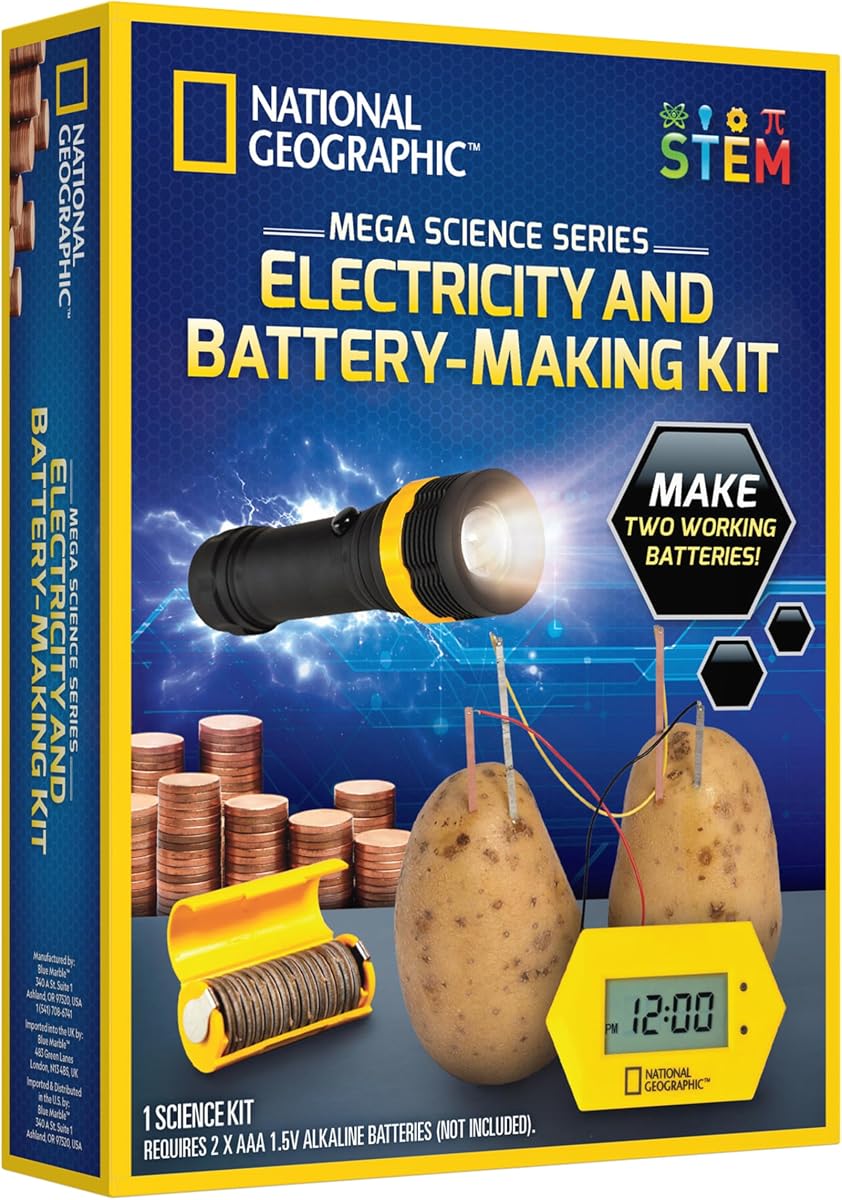
This kit teaches electricity through DIY potato clocks and coin powered flashlights. It includes a voltmeter and detailed learning guide.
We may earn a commission when you buy through this link, at no additional cost to you.
Kids learn why batteries and circuits work through these two projects. It is a memorable way to explore electrical engineering.
You need potatoes and the kit only has two projects. But the focused approach makes it great for curiosity.
Select this for kids who love building and want a focused gift. Blue Marble support ensures a stellar experience.
This project teaches kids about electricity using components to build a DIY potato clock with voltmeter.
Kids construct a battery with coins to make a flashlight light up, demonstrating circuits clearly.
We may earn a commission when you buy through this link, at no additional cost to you.
This upgrade kit helps teachers and students explore more advanced projects like stair switch circuits and traffic lights. It comes ready out of box except for batteries.
We may earn a commission when you buy through this link, at no additional cost to you.
It includes switches, wires, bulbs, and LEDs. The box is transparent for easy access. It covers projects like wind power cars.
You need 2 AA batteries. The transparent box is convenient but check durability. It fits grades 7 to 11.
Choose this for advanced learners wanting more complex circuits. It provides hands-on opportunities effectively.
This project demonstrates how switches can control lights from multiple locations.
Build a traffic light using LEDs to learn about sequencing and control.
We may earn a commission when you buy through this link, at no additional cost to you.
Selecting the right kit depends on age, curriculum goals, and desired depth of experiments. These factors will help you compare options effectively.
Kits vary from basic circuits for younger kids to advanced physics for high schoolers. Check the recommended age or grade range to match your student's math and science background. A mismatch can lead to frustration if too complex or boredom if too simple.
Always verify the grade range on the packaging or product page before purchasing.
Some kits offer just a few simple setups while others provide over 100 projects. More projects mean longer engagement and better value over time. Consider how long you want the student to remain occupied with this single kit.
Prioritize kits with 20 or more experiments for sustained learning and exploration.
Components should be durable and made of safe materials. Look for kits with organized storage cases to prevent losing parts. Quality connectors reduce frustration and ensure reliable results during experiments.
Check reviews for durability reports and inspect storage solutions before deciding.
Clear instructions are essential for independent learning or guided teaching. Kits with full-color manuals, diagrams, or video QR codes reduce setup time and confusion. Detailed step-by-step guidance helps students understand the why behind experiments.
Choose kits with visual aids and online video support for easier adoption.
Safe kits use low-voltage power sources and non-toxic materials. Avoid kits that allow high current or short circuits without protection. Look for warnings about supervision and proper battery usage.
Always ensure adult supervision and follow battery safety rules when using these kits.
Some kits require tools like screwdrivers or wire strippers while others connect without tools. Consider the age of the learner and available tools. Simple snap connectors are more accessible for younger students.
Opt for tool-free kits for younger kids to streamline setup and engagement.
Kits should align with curriculum standards or specific learning goals like magnetism or battery chemistry. Check if the manual explains concepts or just lists steps. Educational depth ensures real understanding beyond building toys.
Select kits with explanations that connect experiments to scientific principles.
Prices range widely from budget-friendly basic kits to premium sets with extensive components. Higher cost often means more projects and better materials. Evaluate long-term value versus immediate cost.
Compare the number of projects per dollar to get the best value.
Read the manual completely before starting any project to understand safety guidelines and required components. Ensure you have all batteries and tools ready before assembling circuits to avoid interruptions.
Supervise younger children when switching on power and checking for heat. Always disconnect circuits immediately if components feel hot or unusual. Never leave active circuits unattended or running for too long to prevent battery leakage.
Store components in the provided container after each session to keep parts organized. Regularly check wires and connectors for wear and replace damaged parts immediately. Keep the manual accessible for future reference and new experiment ideas.
Most kits are suitable for ages 8 and up, with advanced kits aimed at grades 9 to 11. Always check the specific product age recommendation to match the student's skill level.
Most kits do not include batteries. They typically require AA batteries which you will need to purchase separately to power the circuits.
Kits are designed with low voltage and safe components, but adult supervision is recommended. Follow all safety warnings and avoid mixing batteries or leaving circuits active unattended.
Yes, many teachers use these kits for science classes or STEM units. They provide hands-on opportunities for students to explore electricity concepts effectively.
This depends on the specific kit. Basic kits offer around 8 to 18 projects while premium kits offer over 120 projects for extended engagement.
Most kits use snap connectors or screws that do not require tools. Some basic kits may require a screwdriver so check before purchasing.
Contact the seller or manufacturer for support. Many brands offer after-sales service or replacement parts if you provide proof of purchase.
Kits often use similar components like wires and switches which can be shared or expanded. Check compatibility of voltage and connectors before mixing parts from different kits.
Top picks include the EUDAX Basic kit for budget needs, the National Geographic kit for project variety, and the EUDAX Physics Labs kit for advanced learners. Each offers distinct benefits for different ages and goals.
Prioritize kits that match your student's level and include clear instructions. More projects and durable components often deliver better long-term value than minimal sets.
Verify current prices and product details before purchasing. Product availability can change so ensure you have the latest specs to meet your needs.