
ESP8266 ESP-01S
4.4Editor score
4MB Flash Memory
Stronger Signal Strength
Compact Serial Transceiver
This guide compares the top 10 Arduino WiFi Module options for 2026, covering features like dual-core processing, Bluetooth support, and flash memory to help
Finding the right Arduino WiFi Module is crucial for modern IoT projects that need reliable wireless connectivity. Whether you are building smart home devices or industrial sensors, the right module ensures stable data transmission and efficient power usage for your specific application needs.
We compared ten leading options based on connectivity features, processing power, and ease of integration with Arduino IDE. Our analysis covers everything from compact ESP8266 variants to advanced boards with built-in matrices and dual-core processors to help you make an informed decision.
Each pick highlights key strengths like Bluetooth support, flash memory capacity, and voltage requirements. Please note that prices and availability change frequently, so always check current listings before purchasing to ensure you get the best value for your project requirements.
4.4Editor score

4.7Editor score

4.7Editor score
Here is a side-by-side comparison of all ten products to help you evaluate their specific features and capabilities quickly. This table highlights key specifications like processing type, memory size, and connectivity options across the different models available.



The Arduino UNO R4 WiFi stands out as a top choice for advanced IoT projects needing powerful processing and robust wireless connectivity. With a 4.7 rating, it combines a Renesas RA4M1 microcontroller with an ESP32-S3 chip for dual-core performance. This setup supports high-speed communications and edge AI applications effectively.
We may earn a commission when you buy through this link, at no additional cost to you.
Its comprehensive wireless connectivity ensures stable operation for IoT projects, remote sensors, and smart devices. The USB-C port enables efficient power delivery and fast programming compared to older USB connections. Additionally, the Qwiic Connector simplifies adding I2C sensors without complex wiring.
The high-precision 12-bit DAC and OP-AMP provide accurate analog signal generation ideal for audio or sensor interfacing. While the price is higher than basic ESP modules, the integrated features like the LED Matrix and CAN support justify the investment for professional embedded work.
Developers building smart home systems or industrial automation will find this board highly versatile. It delivers seamless operation for real-time data processing and wireless control. We recommend this board for projects needing both analog precision and advanced wireless features in a single package.
Combining Renesas RA4M1 and ESP32-S3 allows running complex tasks simultaneously while maintaining stable wireless communication for IoT applications.
USB-C and Qwiic connectors simplify wiring and power delivery, making prototyping faster and more reliable for advanced embedded projects.
We may earn a commission when you buy through this link, at no additional cost to you.
The ESP8266 ESP-01S from HiLetgo offers excellent value for developers needing basic wireless connectivity on a tight budget. Rated 4.2, it provides robust on-board processing and storage capabilities for simple IoT tasks. This module supports three modes: AP, STA, and AP+STA for flexible networking.
We may earn a commission when you buy through this link, at no additional cost to you.
Its small form factor makes it ideal for wearable electronics or smart home sensors where space is limited. The module is fully compatible with Arduino IDE allowing quick setup for wireless communication projects. Users appreciate the LWIP stack support for seamless integration.
While it lacks some advanced features like built-in analog output, it delivers reliable wireless transmission for most entry-level projects. Keep in mind that careful voltage management is needed since it operates at 3.3V. Overall it remains a go-to choice for cost-effective connectivity.
Beginners and hobbyists should consider this module for initial prototypes or large scale sensor networks. It balances cost and performance well for simple data transmission tasks. We recommend pairing it with an external level shifter for Arduino Uno compatibility.
Supporting AP, STA, and AP+STA modes allows this module to act as a router or client depending on project requirements easily.
The small serial transceiver design saves space on breadboards and PCBs while maintaining reliable serial communication capabilities.
We may earn a commission when you buy through this link, at no additional cost to you.
The ELEGOO 3PCS ESP-32 delivers premium performance with dual-core capabilities up to 240 MHz for complex embedded tasks. Rated 4.7, these boards support responsive sensor processing and wireless communication for automation logic. The built-in Wi-Fi and Bluetooth 4.2 cover most connectivity needs for smart devices.
We may earn a commission when you buy through this link, at no additional cost to you.
Modern USB-C programming simplifies power delivery and sketch uploads compared to older micro-USB standards. The boards support flexible power-saving modes like dynamic clock scaling which reduces energy consumption significantly. This makes them suitable for battery-powered IoT devices running on limited power sources.
Over-the-Air update support allows deploying firmware changes over Wi-Fi without physical reconnection to every device. While the USB-C cable is not included, the port itself offers faster and more stable connections for development. These boards balance power and efficiency exceptionally well.
Engineers building connected home systems or industrial sensors will appreciate the reliability and performance of these ESP-32 boards. They handle real-time data processing with ease while maintaining low power consumption. We recommend this set for projects requiring both speed and wireless versatility.
Dual-core architecture running up to 240 MHz enables efficient multitasking for complex sensor and wireless communication tasks simultaneously.
Dynamic clock scaling and low-power modes extend battery life in remote monitoring devices while maintaining high performance when needed.
We may earn a commission when you buy through this link, at no additional cost to you.
The ESP8266 ESP-01S with 4MB Flash offers substantial storage for projects needing to store data locally or run larger sketches. Rated 4.4, it features the latest ESP-01S version with stronger signal performance compared to previous iterations. This module provides reliable wireless connectivity for various sensor networks.
We may earn a commission when you buy through this link, at no additional cost to you.
Users should choose the Generic ESP8266 Module board in Arduino IDE to program this device effectively. The 4MB capacity allows for complex applications or local caching without relying heavily on cloud storage. This is particularly useful for offline data logging tasks.
While the signal strength is improved, care must be taken with voltage as it strictly requires 3.3V power. The compact design makes it easy to integrate into custom PCBs or breadboards for prototyping. It is a reliable choice for mid-level wireless projects.
Hobbyists building data loggers or standalone sensor nodes will benefit from the extra flash space. It balances cost and capability effectively for projects needing more than standard memory. We recommend this model for applications requiring local data retention capabilities.
4MB Flash Memory allows storing more code and data locally which is beneficial for logging sensors or complex standalone applications.
The latest ESP-01S version provides stronger wireless signals ensuring more reliable connections for remote projects than earlier models.
We may earn a commission when you buy through this link, at no additional cost to you.
The Aitrip 5-piece ESP8266 kit provides excellent value for developers needing multiple modules for large projects or prototyping. Rated 4.4, each unit supports AP, STA, and AP+STA modes for versatile networking options. These modules are compatible with Arduino NodeMCU and support AT+Commands directly.
We may earn a commission when you buy through this link, at no additional cost to you.
Ideal for smart grids or transportation projects, these modules offer reliable wireless transceiver capabilities. They work well with industrial control systems and handheld devices requiring connectivity. Keep in mind the 3.3V voltage requirement and ensure proper interfacing with 5V boards.
The kit ensures you have enough modules for testing or multi-device deployments without buying individually. Each module includes SPI Flash memory and is ready for standard AT commands. The broad application range makes them suitable for many different use cases.
Project builders needing multiple nodes for a sensor network will appreciate the cost savings of this kit. It simplifies purchasing and ensures consistency across all devices in your system. We recommend this set for large scale IoT prototypes or classroom projects.
Supporting AP, STA, and combined modes allows flexible configuration as both access points and clients in various network topologies.
Buying a 5-piece kit saves money compared to purchasing individual units and ensures consistent performance across multiple devices.
We may earn a commission when you buy through this link, at no additional cost to you.
The Arduino Nano ESP32 delivers high performance with a dual-core ESP32-S3 microcontroller capable of machine learning at the edge. Rated 4.5, it supports Wi-Fi and Bluetooth 5.0 for reliable low-latency data transfer. The board includes HID support for custom input devices like keyboards.
We may earn a commission when you buy through this link, at no additional cost to you.
Its MicroPython compatibility makes rapid prototyping easier for developers familiar with Python scripts. This feature simplifies testing and iteration for embedded applications significantly. The modern USB-C port ensures efficient power delivery and faster programming compared to older standards.
While the board is sold without headers, it offers significant flexibility for production stages with stable connections. The low-latency wireless transfer ensures remote sensors and smart home devices perform smoothly. This board bridges the gap between embedded C++ and Python programming.
Python developers looking for embedded solutions will find this board ideal for interactive coding and quick testing. It balances modern features like Bluetooth 5.0 with flexible programming environments. We recommend this board for developers who prefer Python for prototyping.
MicroPython compatibility allows developers to use Python for embedded logic, making rapid prototyping and testing faster than traditional C++.
Bluetooth 5.0 and Wi-Fi ensure stable low-latency data transfer crucial for real-time remote sensing and smart home automation tasks.
We may earn a commission when you buy through this link, at no additional cost to you.
This 4-pack of ESP8266 ESP-01S modules provides reliable wireless connectivity for wearable electronics and home automation. Rated 4.4, the transceiver modules are made of good material for multiple reuse. They feature self-calibrated RF units to ensure optimal performance across different applications.
We may earn a commission when you buy through this link, at no additional cost to you.
These modules are well-suited for sensor networks where multiple nodes need consistent performance. The compact design allows for easy integration into small electronics or custom enclosures. Their reusability makes them a sustainable choice for iterative prototyping stages.
While they work well, users should ensure proper voltage level shifting as they operate at 3.3V. The RF performance is optimized for various scenarios including wireless location sensing. This pack offers a solid foundation for building small scale IoT systems.
Builders of sensor networks or location sensing devices will find these modules consistent and reliable. Their material quality ensures longevity during repeated development cycles. We recommend this pack for projects requiring multiple small wireless nodes.
Constructed from good materials, these modules are durable and reusable, saving costs over multiple prototyping projects and long term usage.
Self-calibrated RF units optimize wireless transmission and ensure optimal performance for various sensor and location sensing tasks.
We may earn a commission when you buy through this link, at no additional cost to you.
This 5-pack includes ESP8266 ESP-01S modules with 4MB Flash for ample storage. Rated 4.5, these modules support 115200 baud rates for fast data transfer. They require careful attention to voltage since they only support 3.3V without 5V tolerance.
We may earn a commission when you buy through this link, at no additional cost to you.
Users must select SPI MODE as DOUT in Arduino IDE to program these modules correctly. The 4MB Flash allows for larger applications or local data storage which is rare for this size module. This pack is excellent for Internet of Things projects needing memory.
The requirement for specific SPI settings adds a slight complexity step for beginners. However the high performance and large storage make up for this minor hurdle. These boards are designed for serious IoT implementation rather than basic blinking LED tasks.
Developers needing high data rates and storage for IoT systems will find this kit valuable. It offers a balance of capability and cost for advanced microcontroller projects. We recommend this set for complex IoT nodes requiring local storage.
Supporting 115200 baud rates ensures rapid communication between the module and host microcontrollers for real-time IoT data handling.
4MB Flash Memory provides ample room for storing complex code and local data, essential for advanced sensor nodes and IoT apps.
We may earn a commission when you buy through this link, at no additional cost to you.
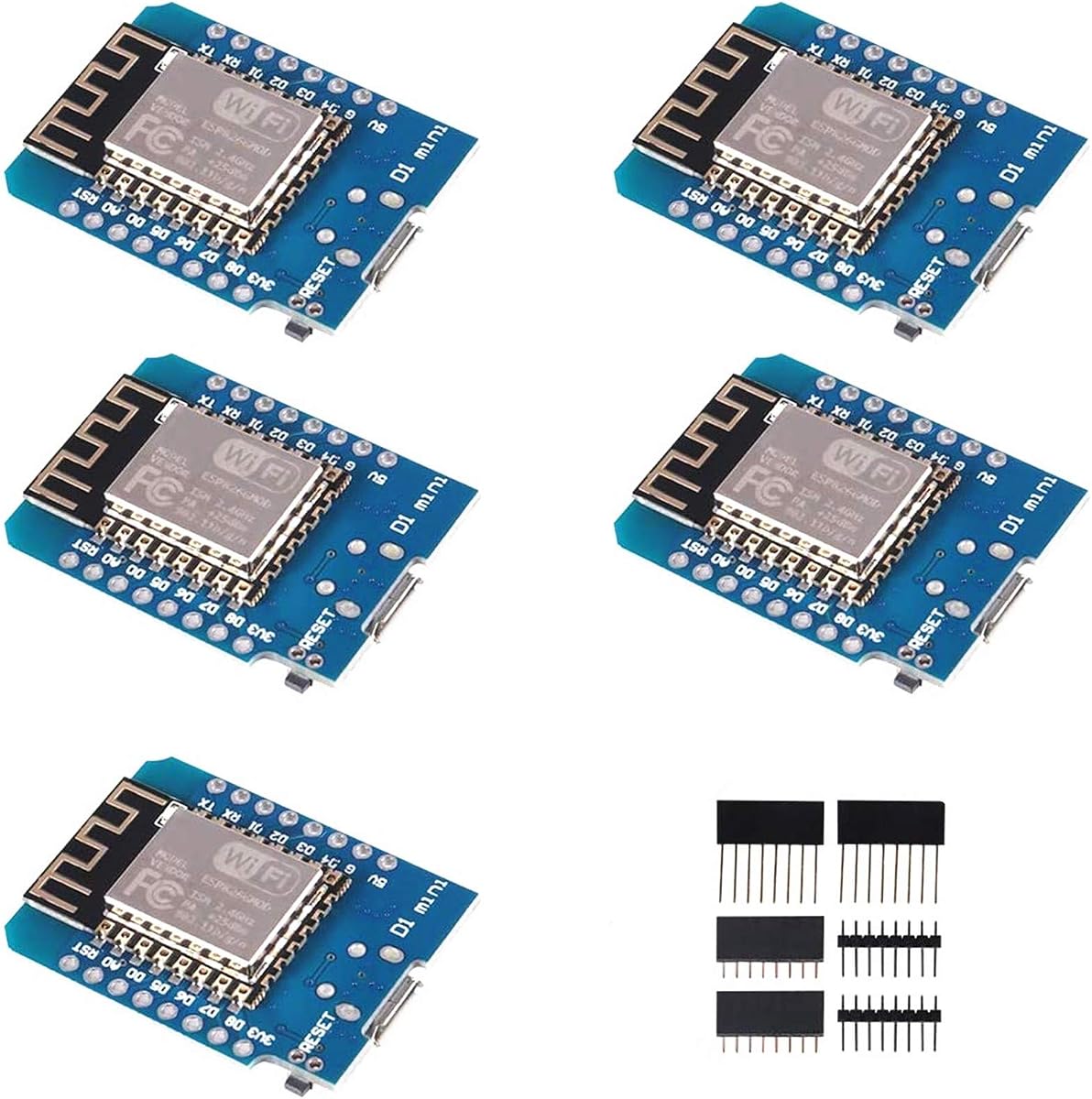
This 5-pack features ESP8266 ESP-12F modules with a NodeMcu Mini D1 style design. Rated 4.5, these boards offer 11 digital input/output pins with interrupt and PWM support. They include 4M Bytes Flash memory and Micro USB connection for easy integration.
We may earn a commission when you buy through this link, at no additional cost to you.
Compatible with Arduino IDE WeMos and Lua, these boards support versatile programming environments. They come with onboard switching power supplies which simplifies power requirements significantly. However, analog input is limited to 3.2V so careful voltage division is needed.
The onboard fuse and power supply make these boards user-friendly for direct connection to USB power. They support 5V 1A switching power supply onboard which aids reliability. These are excellent for prototyping where quick connectivity is prioritized.
Projects needing many GPIO pins will benefit from the 11 digital I/O capabilities. The Micro USB connection is a modern touch that simplifies power and programming. We recommend this kit for users preferring D1 mini style hardware.
With 11 digital input output pins supporting PWM and interrupt, this board allows complex hardware interfacing without external expanders.
Integrated switching power supplies and fuses simplify power management and provide stable voltage for connected components directly.
We may earn a commission when you buy through this link, at no additional cost to you.
This 10-Pack offers a robust solution for wireless connectivity projects needing many nodes. Rated 5.0, these ESP8266 ESP-01 modules feature ample on-board storage for seamless data retention. They support AP STA and AP+STA modes for versatile networking options across large areas.
We may earn a commission when you buy through this link, at no additional cost to you.
The modules facilitate efficient execution of complex tasks and algorithms thanks to robust on-board processing capabilities. They are equipped with LWIP in AP+STA mode to streamline development and enhance project compatibility. This allows for flexible configuration in many different network setups.
While the compact design requires careful handling and voltage management, the value of a 10-pack is significant. It reduces the need for separate purchases and ensures consistency across all deployed units. This is ideal for production prototyping or classrooms.
Teams building large sensor networks or smart home systems will appreciate the quantity and performance. It simplifies logistics and ensures each node operates identically. We recommend this pack for large scale deployments needing reliability.
A 10-pack ensures you have enough units for extensive projects or spare parts, offering cost savings compared to buying individually.
LWIP support in AP+STA mode simplifies networking logic and enhances compatibility with various development frameworks and protocols.
We may earn a commission when you buy through this link, at no additional cost to you.
Selecting the right module requires balancing connectivity, performance, and ease of use for your specific application needs.
Wi-Fi alone is common but Bluetooth support offers better interaction with mobile devices. Look for modules that support both 5GHz and 2.4GHz if you need broader range or specific network bands.
Choose modules with dual-band or combined connectivity to ensure flexibility in various network environments and device pairings.
Dual-core processors like the ESP32-S3 handle complex tasks better than single-core units. If your project involves machine learning or real-time data processing, prioritize boards with higher MHz ratings.
Higher processing speeds prevent lag and allow complex calculations without external hardware support.
Flash capacity determines how much code or local data you can store. Standard 1MB modules suffice for simple scripts but 4MB is needed for larger applications or offline storage.
Verify Flash capacity to ensure you can store necessary libraries and local data without cloud dependency.
Most WiFi modules run at 3.3V while standard Arduino boards use 5V. Ensure you have level shifters or a 3.3V regulator before connecting pins directly to avoid damage.
Check voltage compatibility and prepare necessary level shifters to prevent hardware damage during connection.
USB-C ports offer faster data transfer and power delivery compared to Micro-USB. Modern boards with USB-C simplify updates and reduce cable clutter during development.
Prefer USB-C interfaces for improved durability and faster firmware updates during development cycles.
Battery-powered projects require efficient sleep modes and low current consumption. Look for dynamic clock scaling and sleep features to extend battery life significantly.
Select modules with low power modes to maximize runtime for battery-operated IoT devices.
The number of available pins affects how many sensors you can connect directly. Modules with more digital and analog pins reduce the need for expanders.
Count required inputs and outputs to choose a module that supports your hardware without extra expansion boards.
Some projects like wearables need small form factors like the ESP-01S. Others like home hubs need boards with built-in connectors and LEDs.
Choose a form factor that fits your enclosure and physical space requirements easily.
Install the Arduino IDE and select the correct board and port in tools before programming. Ensure you have installed necessary drivers like CP2102 or CH340 for USB connections to work correctly.
When connecting to your computer or power source, use stable cables and avoid loose connections that cause resets. If using a breadboard, ensure jumpers are firmly seated and power rails are properly connected for stability.
Keep modules in dry storage when not in use and protect from static electricity. Avoid touching exposed pins directly with bare hands to prevent corrosion or damage to sensitive components over time.
For beginners, the Arduino UNO R4 WiFi is ideal because it integrates connectivity directly into a familiar board without extra wiring. Alternatively, the ESP-01S with an external programmer is a cheap way to learn basic wireless protocols. Start with the R4 to avoid voltage complexity initially.
ESP8266 modules operate at 3.3V and may burn out if connected directly to 5V Arduino pins. You must use voltage level shifters for TX RX and GPIO lines to match voltage levels safely. Ensure stable power supply to prevent brownouts.
ESP32 offers dual-core processing Bluetooth support and more GPIO pins compared to the single-core ESP8266. ESP32 is more powerful for complex tasks while ESP8266 is simpler and cheaper for basic sensor data transmission. Choose based on processing needs.
You need to write code defining your SSID and password using Wi-Fi libraries in Arduino IDE. Upload the code and open serial monitor to check the connection status IP address printed. Ensure your router allows connections from unknown devices.
ESP8266 modules do not support Bluetooth but newer ESP32 boards include dual-band Bluetooth 4.2 or 5.0. If Bluetooth pairing is essential for your project choose an ESP32-based board instead of an ESP8266 variant for full wireless coverage.
A stable 3.3V supply capable of delivering at least 500mA is recommended for reliable operation. Using a separate USB power source or LDO regulator avoids voltage drops during transmission. Ensure ground connections are solid across all components.
Check for interference from other devices or weak signal strength in your location. Ensure power supply is stable and voltage does not dip below 3.3V during transmission. Try moving the module closer to the router to verify signal range first.
Yes many ESP32 boards support Over-the-Air updates via Wi-Fi without physical cables. Enable OTA libraries in Arduino IDE to deploy changes remotely once connected. This is useful for deployed devices in hard to reach locations.
The Arduino UNO R4 WiFi offers the most complete package for professionals needing dual-core power and integrated Bluetooth. For budget conscious projects the ESP8266 ESP-01S remains a reliable choice for simple data transmission tasks.
When choosing prioritize your connectivity needs power consumption and processing power to match your project goals. Selecting the right voltage and memory specifications ensures long term reliability and avoids unnecessary hardware upgrades later.
Prices and availability fluctuate frequently so always check current listings before finalizing your purchase. Verify component availability and bundle offers to ensure you get the best value for your specific build requirements.