
WWZMDiB 5 Pcs Power Supply Module
4.2Editor score
Includes five 9V connectors
Compatible with 400 and 830 points
Supports USB and DC input
This guide compares the top 12V Breadboard Power Supply units for makers and engineers, evaluating features, compatibility, and reliability for your prototyping
Finding the right power source for your electronics projects can be tricky. A reliable 12V Breadboard Power Supply ensures stable voltage for your microcontrollers and sensors without risking damage.
We compared ten highly rated models based on input options, output stability, and ease of use. Our analysis covers everything from budget-friendly modules to advanced kits with adjustable outputs.
Each pick highlights key strengths and potential trade-offs to help you decide. Keep in mind that prices and availability change frequently, so verify current details before purchasing.
4.2Editor score

4.5Editor score

4.8Editor score
This table provides a side-by-side overview of all ten selected power supply units, highlighting their core specifications and key features for quick comparison.



This module stands out as a top choice due to its flexibility and safety features. It holds a strong rating from users who value reliable power for their breadboard projects.
We may earn a commission when you buy through this link, at no additional cost to you.
The dual input capability allows you to use either USB Type-C or a standard DC jack. This convenience means you can use modern chargers without hunting for old adapters.
Independent switches for each rail let you power different voltages simultaneously. Short-circuit protection ensures your expensive components remain safe during prototyping.
Ideal for students and hobbyists who need multiple power stations. It offers a balance of features and reliability that justifies its price point.
You can choose between USB Type-C or DC jack inputs to match your available power sources.
Separate switches allow you to control each power rail independently for different project needs.
We may earn a commission when you buy through this link, at no additional cost to you.
This product offers excellent value for those needing multiple power units on a tight budget. It provides standard functionality without extra frills.
We may earn a commission when you buy through this link, at no additional cost to you.
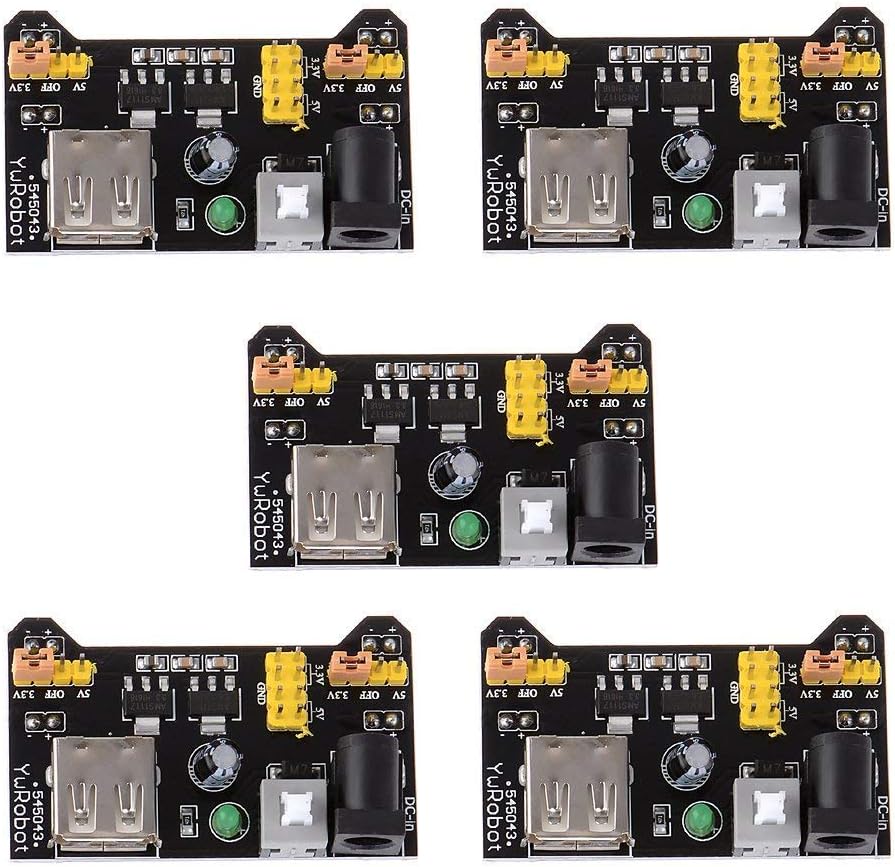
The inclusion of five 9V connectors makes it easy to power projects with batteries. This is great for portable prototypes or classrooms.
It supports the common 6.5 to 12V input range and delivers stable 3.3V or 5V outputs. The current limit is suitable for most sensors and microcontrollers.
Best for educators or students stocking up supplies. It performs reliably for general circuit testing and learning purposes.
Included connectors make it easy to integrate 9V batteries for mobile projects.
Buying five units at once ensures you have backups for multiple workstations.
We may earn a commission when you buy through this link, at no additional cost to you.
This kit is perfect for beginners who want everything in one box. It includes a breadboard, power module, and jumper wires.
We may earn a commission when you buy through this link, at no additional cost to you.
The included 12V adaptor ensures you have a stable power source right out of the box. This simplifies the setup process significantly.
The power module supports standard 3.3V and 5V outputs. The current limit is suitable for small projects and testing components.
Ideal for students or hobbyists starting their first electronics journey. It removes the hassle of sourcing individual parts.
Everything you need to start prototyping is included in a single purchase.
A dedicated 12V adaptor is included to ensure consistent voltage delivery.
We may earn a commission when you buy through this link, at no additional cost to you.
HiLetgo is a known brand in the maker community for reliability. This pack provides five units for extensive prototyping needs.
We may earn a commission when you buy through this link, at no additional cost to you.
The design is straightforward, delivering 3.3V and 5V outputs easily. It accepts both USB and DC power sources up to 9V.
The current limit is typical for these modules, fitting most low-power electronics. It is a solid choice for classroom environments.
Best for those needing multiple units without complex features. It gets the job done efficiently and affordably.
HiLetgo has a strong reputation for consistent performance and durability.
Getting five units in one purchase is cost-effective for large projects.
We may earn a commission when you buy through this link, at no additional cost to you.
This module earns high praise for its seamless integration with standard breadboards. It is built with high-quality components for stability.
We may earn a commission when you buy through this link, at no additional cost to you.
It supports a wide input range and offers selectable 3.3V or 5V outputs. This flexibility works well for various microcontrollers and sensors.
The design ensures stable power distribution without complex wiring. Users appreciate its reliability during long experiments.
Recommended for hobbyists needing a dependable single module. It is easy to install and use effectively.
Designed specifically to fit perfectly into standard breadboard power rails.
Quality components ensure stable power distribution for your projects.
We may earn a commission when you buy through this link, at no additional cost to you.
This pack is designed for ease of use with standard breadboards. It offers a plug and play experience without extra wiring.
We may earn a commission when you buy through this link, at no additional cost to you.
The LED indicator provides clear visual feedback on power status. Included 9V battery cables add flexibility for portable projects.
Dual voltage support allows selection between 3.3V and 5V. It is a solid choice for general educational purposes.
Ideal for schools or makers needing simple power solutions. It delivers consistent performance for basic electronics.
A green LED indicator clearly shows when the power is active.
Included cables allow easy connection to 9V batteries for portability.
We may earn a commission when you buy through this link, at no additional cost to you.
This kit offers advanced customization with an adjustable output and digital display. It is ideal for those comfortable with soldering.
We may earn a commission when you buy through this link, at no additional cost to you.
The LM2596 module provides multiple fixed and adjustable voltages. This flexibility supports analog circuits and varied component needs.
The built-in display allows you to confirm settings before connecting. It reduces trial and error during circuit setup.
Best for electronics labs or advanced makers. It provides a deeper understanding of power supply design.
Adjustable output voltage supports complex projects beyond standard levels.
Visual confirmation of output voltage improves accuracy and confidence.
We may earn a commission when you buy through this link, at no additional cost to you.
This module stands out by offering significantly higher current output. It supports demanding projects like Raspberry Pi or multiple sensors.
We may earn a commission when you buy through this link, at no additional cost to you.
The inclusion of a USB output adds another layer of versatility for powering USB devices. It is compact enough for portable setups.
Stable and reliable power ensures your components operate correctly. The on/off switch makes usage straightforward and safe.
Ideal for IoT and robotics projects requiring more power. It is a robust choice for advanced hobbyists.
Higher current output supports components that draw more power.
Integrated USB port allows direct power to compatible devices.
We may earn a commission when you buy through this link, at no additional cost to you.
This premium option offers extensive voltage flexibility and high efficiency. It supports a wide input range from 5V up to 40V.
We may earn a commission when you buy through this link, at no additional cost to you.
Multiple channels allow you to run different voltage rails simultaneously. The adjustable output adds significant value for advanced testing.
The switching design ensures efficient power conversion with less heat. It is perfect for diverse electronics projects.
Best for users needing broad voltage options. It delivers professional-grade performance in a compact module.
Accepts input from 5V to 40V, offering incredible flexibility.
High efficiency ensures less heat and better power management.
We may earn a commission when you buy through this link, at no additional cost to you.
This adapter serves as a robust benchtop power source for diverse projects. It offers adjustable voltage and clear LCD readouts.
We may earn a commission when you buy through this link, at no additional cost to you.
The high current capacity allows powering larger devices like strips or motors. Safety protections ensure reliable operation without risk.
Multiple DC tips ensure compatibility with various devices. Use the alligator clip cable to connect to breadboards.
Ideal for workshops needing a versatile power solution. It is a reliable alternative to fixed voltage modules.
Adjustable output from 3V to 24V covers most common requirements.
Built-in protections guard against short circuits and overloads.
We may earn a commission when you buy through this link, at no additional cost to you.
Selecting the right power supply involves considering compatibility, output requirements, and safety features. This guide outlines key factors to ensure you choose a suitable unit.
Ensure the module accepts your available power source, such as 5V USB or 12V DC. Mismatched inputs can prevent operation or damage the unit.
Check that the input range matches your adapter or battery pack specifications.
Determine if you need fixed outputs like 3.3V or 5V, or adjustable ones for flexible testing. Most microcontrollers require specific voltages.
Select units with jumper or switch controls for easy voltage selection.
Calculate the total current your components will draw. Standard modules often max out around 700mA, while advanced ones support higher loads.
Choose a unit with headroom to prevent brownouts or unstable operation.
Standard modules plug directly into breadboard power rails. Some units require separate wiring or alligator clips for connection.
Plug-and-play designs save time and reduce wiring clutter.
Look for short-circuit and over-current protection to safeguard your components. These features prevent damage during accidental wiring errors.
Safety features are critical for expensive electronics and sensors.
Decide between a compact module and a larger benchtop adapter. Compact units save space on the breadboard.
Larger adapters provide more power but take up more desk space.
If you move projects often, consider units that support battery input. This allows testing away from a power outlet.
Portability is key for field testing or classroom use.
Select units with quality components for stability. Cheap modules may overheat or fail over time.
Reading reviews helps confirm the durability of the unit.
To use a standard module, plug it into the power rails on your breadboard. Connect your power adapter to the DC jack or USB port securely.
Check the jumper or switch settings to select the desired voltage. Ensure the setting matches your project's voltage requirements before connecting components.
Avoid overloading the unit by checking current limits. Regularly inspect cables for damage and store the unit in a dry place.
Yes, many modules accept USB input, typically 5V. Ensure your power bank has sufficient current capacity for your project to maintain stability.
Fixed outputs provide specific voltages like 3.3V or 5V directly. Adjustable outputs allow you to change the voltage manually, offering flexibility for different experiments.
The LED indicates that the module is receiving power. It helps you quickly confirm if the power supply is active during testing.
Yes, if your source provides enough current. Ensure the total current draw does not exceed the adapter's rated capacity.
Not if you use USB. However, for 12V input, you will need a compatible DC adapter. Check the module input specifications carefully.
The voltage may drop, causing instability. Some modules have protection circuits that shut off to prevent damage to components or the unit itself.
Our top picks offer a range of options from basic budget units to advanced adjustable power supplies. Each serves specific prototyping needs effectively.
Prioritize safety features and compatibility with your devices. The right choice ensures stable testing and protects your electronics from damage.
Prices and stock fluctuate often. Verify current details and reviews before purchasing to ensure you get the best value.