
10Gtek X540
4.1Editor score
Intel X540 controller
Dual RJ45 ports
3-year warranty included
Discover the top 10GB Ethernet cards for speed and stability. This guide compares leading 10G network adapters for gaming, NAS, and server needs.
Upgrading your network infrastructure often starts with a reliable 10GB Ethernet card. These adapters deliver ten times the speed of standard connections, essential for modern high-bandwidth tasks like 4K editing and cloud backups.
We evaluated ten top-rated PCIe and USB adapters based on chipset performance, compatibility, thermal management, and real-world throughput. Our analysis covers options from budget-friendly picks to enterprise-grade solutions for diverse computing environments.
Each pick highlights key strengths, ideal use cases, and important limitations to watch. Prices and availability change frequently, so verify current deals before purchasing to ensure you get the best value for your specific setup.
4.1Editor score

4.2Editor score

4.6Editor score
The table below provides a side-by-side comparison of all ten products. We highlight key specifications, supported operating systems, and unique features to help you quickly identify the right adapter for your specific networking needs.



The TP-Link TX401 stands out as the top choice for users seeking a straightforward upgrade to 10Gbps speeds. With a solid rating of 4.2 stars, it balances performance with affordability effectively for home and small office use.
We may earn a commission when you buy through this link, at no additional cost to you.
Its 10GBase-T technology ensures seamless backward compatibility with lower-speed networks, automatically negotiating connections. The included CAT6A cable saves cost and guarantees you have the right cabling to reach full speed immediately.
While it only offers a single port, this simplifies installation and power usage. The low-profile bracket makes it ideal for mini-tower cases where space is constrained, ensuring broad physical compatibility across different chassis.
We recommend this card for anyone wanting a reliable entry into 10GbE networking without breaking the bank. It suits general users upgrading PCs for gaming, content creation, or faster local file transfers efficiently.
The included CAT6A cable ensures you can achieve maximum speeds immediately without purchasing extra accessories separately.
Dual brackets allow installation in both full-height and low-profile cases, maximizing compatibility with smaller computer builds.
We may earn a commission when you buy through this link, at no additional cost to you.
The VIMIN Dual Port card delivers exceptional value for users needing redundancy or link aggregation. Boasting a 4.5-star rating, it leverages the robust Intel X540-T2 controller for stable performance in demanding server environments.
We may earn a commission when you buy through this link, at no additional cost to you.
Its dual ports allow for network failover or bandwidth aggregation, crucial for maintaining uptime in mission-critical setups. The heat sink ensures thermal stability during heavy usage, preventing throttling over extended periods.
One limitation is the lack of 2.5G and 5G speed support, limiting compatibility with some modern consumer routers. However, for pure 10G and 1G switching, it remains a highly capable and budget-friendly solution.
This card is best suited for sysadmins or home lab enthusiasts requiring dual connections. If you need stability and flexibility at a low cost, the VIMIN offers a strong alternative to pricier branded options.
Dual ports enable link aggregation or failover configurations, improving throughput and network reliability for critical tasks.
Integrated heat sink design helps maintain optimal operating temperatures during sustained high-bandwidth transfers.
We may earn a commission when you buy through this link, at no additional cost to you.
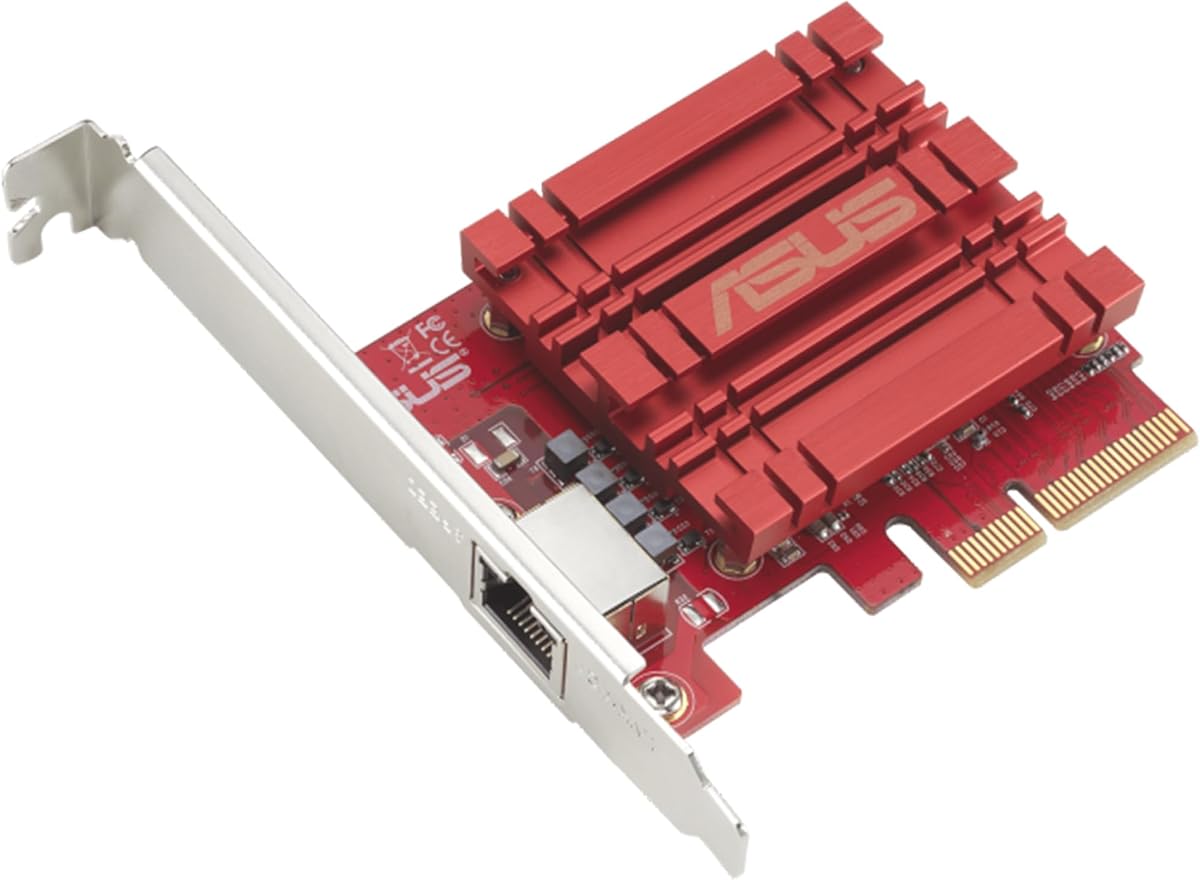
Asus brings its reputation for quality hardware to this single-port 10GbE adapter. Rated at 4.1 stars, it focuses on delivering smooth data transfers with built-in Quality of Service to prioritize traffic effectively.
We may earn a commission when you buy through this link, at no additional cost to you.
The QoS technology is a key advantage for gamers and streamers, ensuring critical packets get priority. This prevents network congestion during high-activity periods, making it ideal for shared home networks.
While it supports Windows and Linux kernels thoroughly, the higher price compared to competitors might be a consideration. It is a premium single-port option for users who trust the Asus ecosystem and need traffic management.
Choose this card if you value brand reliability and specific traffic control features. It fits well in home entertainment centers where optimizing bandwidth for gaming or streaming is a top priority.
Built-in QoS technology prioritizes data packets to ensure smooth online experiences during peak network usage.
Supports multiple Windows versions and Linux kernels, making integration into diverse operating systems straightforward.
We may earn a commission when you buy through this link, at no additional cost to you.
The 10Gtek X540 offers an unbeatable price for those needing dual 10G ports without paying a premium. With a 4.1-star rating, it provides stable connectivity powered by the well-regarded Intel X540 controller chip.
We may earn a commission when you buy through this link, at no additional cost to you.
Its compatibility with Windows Server and Linux makes it a versatile tool for server administrators. The dual copper RJ45 ports allow for flexible connection options in data center or home lab environments.
Users on Windows 11 may need to manually configure drivers, which is a minor hurdle for a budget card. However, the included low-profile bracket ensures it fits into compact chassis where space is limited.
This card is perfect for builders maximizing value per port. If you need redundancy or bandwidth aggregation on a strict budget, the 10Gtek delivers reliable performance without unnecessary extras.
Equipped with Intel X540 controller for stable performance and support of advanced offload features.
Includes low-profile bracket for easy installation in smaller computer cases and servers.
We may earn a commission when you buy through this link, at no additional cost to you.
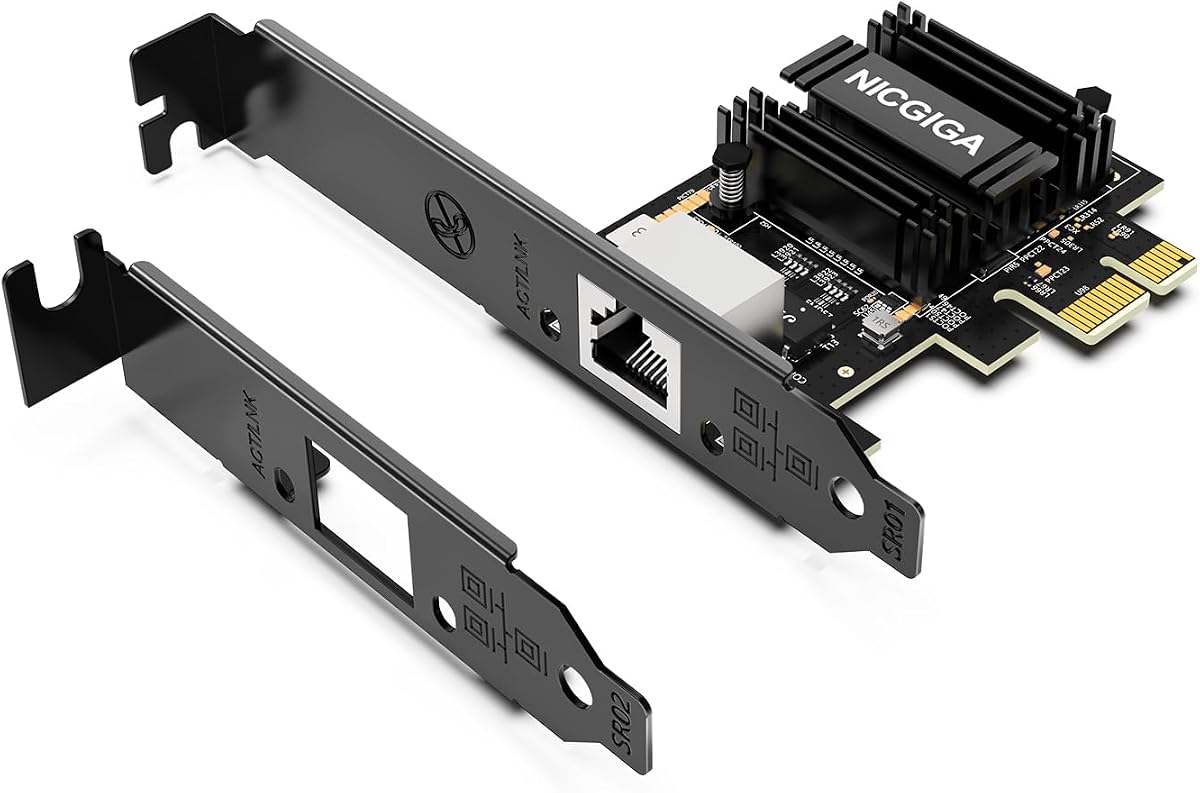
The NICGIGA RTL8127 excels in compact builds where space is at a premium. Rated at 4.3 stars, it leverages PCIe 4.0 x1 to deliver 10G speeds while maintaining low power consumption and heat output.
We may earn a commission when you buy through this link, at no additional cost to you.
Its Realtek chipset offers efficient performance, ideal for NAS storage and home labs where power efficiency matters. Auto-negotiation ensures smooth integration with various routers and switches without manual speed configuration.
Because it fits in an x1 slot, it leaves other lanes available for GPUs or other expansion cards. This makes it perfect for Mini PCs or ITX builds where physical clearance is a major constraint.
Choose this card for compact workstation upgrades. It balances speed and size effectively, making it a top pick for small form factor enthusiasts needing high-speed networking.
Realtek RTL8127 controller ensures efficient power use and minimal heat generation for compact setups.
Designed for PCIe x1 slots, freeing up x4 or x16 slots for other critical hardware components.
We may earn a commission when you buy through this link, at no additional cost to you.
The VunLink RTL8127 is tailored for NAS environments requiring flexible speeds. With a 4.3-star rating, it supports 10G, 5G, and 2.5G auto-negotiation, ensuring seamless integration with existing network infrastructure.
We may earn a commission when you buy through this link, at no additional cost to you.
Its energy-efficient design reduces power draw, which is crucial for always-on NAS devices. The low power consumption helps maintain stability during large file transfers without excessive heat generation.
While it shares the same controller as the NICGIGA, the branding focuses on broader server and NAS compatibility. It includes both brackets for flexible installation in various chassis types and sizes.
This card is ideal for home lab and NAS users. If your setup needs to negotiate speeds dynamically with different switches or routers, the VunLink provides the versatility to handle mixed network environments.
Auto-negotiation across 10G, 5G, and 2.5G ensures compatibility with diverse routers and network switches.
Low power consumption design suits always-on storage systems requiring stable and efficient networking.
We may earn a commission when you buy through this link, at no additional cost to you.
The Asus XG-C100F is unique for its SFP+ cage, supporting fiber optic and direct-attach copper connections. Rated at 4.3 stars, it offers a pathway to 10Gbps speeds over much greater distances than copper.
We may earn a commission when you buy through this link, at no additional cost to you.
Its built-in aluminum heatsink ensures cooling during high-performance tasks, maintaining stability under load. Automatic QoS prioritization boosts bandwidth for important streams, keeping network traffic efficient during peak usage.
While fiber optics require specific transceivers or DAC cables, the card supports the latest fiber optic technology. This makes it ideal for environments where distance or interference is a significant constraint for standard copper.
Choose this card for enterprise or specialized home setups needing fiber connectivity. If your network requires long-distance runs or immunity to electromagnetic interference, the XG-C100F delivers reliable performance.
SFP+ cage allows for fiber optic and direct-attach copper connections, supporting high-speed transmission over distance.
Stylish aluminum heatsink keeps the adapter cool during demanding networking tasks to ensure consistent speeds.
We may earn a commission when you buy through this link, at no additional cost to you.
The Synology E10G30-T2 is purpose-built for Synology NAS users seeking seamless integration. With a 4.6-star rating, it delivers dual 10GbE ports designed specifically to maximize storage performance within the DSM ecosystem.
We may earn a commission when you buy through this link, at no additional cost to you.
Its dual ports support high-performance storage applications, enabling link aggregation or dedicated backup traffic. The 5-year warranty offers peace of mind for long-term reliability in demanding storage environments.
While it is optimized for Synology systems, the cost is higher than third-party alternatives. However, the guaranteed compatibility and ease of setup justify the investment for users fully invested in Synology hardware.
This is the top choice for Synology owners needing high-speed access. If you run a Synology NAS and want dual 10GbE connections with minimal configuration effort, this adapter is unmatched.
Purpose-built for Synology systems to ensure smooth operation and maximum compatibility with DSM updates.
Two 10GbE ports support high-performance storage applications, allowing for redundancy or bandwidth aggregation.
We may earn a commission when you buy through this link, at no additional cost to you.
The TRENDnet TEG-10GECTX stands out for its NDAA and TAA compliance, meeting government standards. Rated at 4.1 stars, it offers a PCIe Gen 2/3.0 x4 interface, ensuring reliable performance across multiple operating systems.
We may earn a commission when you buy through this link, at no additional cost to you.
Its support for 2.5G BASE-T allows connection over existing Cat5e cables up to 55 meters, providing flexibility for older wiring. This makes it suitable for office environments where new cabling might not be feasible.
The manufacturer offers 3 years of protection and reliable tech support. This commitment to customer service makes it a strong candidate for businesses needing dependable networking hardware without enterprise-level complexity.
Choose this card for compliance and compatibility. If you need an adapter that adheres to specific regulatory standards or works with legacy cabling, TRENDnet delivers a solid, professional solution.
NDAA and TAA compliant adapters ensure you can plan and install networking solutions that government customers demand.
2.5G BASE-T support allows using existing Cat5e cables, reducing infrastructure costs for legacy setups.
We may earn a commission when you buy through this link, at no additional cost to you.
The Cable Matters USB-C adapter provides a simple way to get 10GbE speeds on modern laptops. Rated at 3.9 stars, it avoids internal installation, offering plug-and-play convenience for Mac and Windows users alike.
We may earn a commission when you buy through this link, at no additional cost to you.
Its advanced RTL8159 chipset ensures low heat and silent operation, perfect for quiet environments. While real-world throughput varies by Mac model, it delivers reliable speeds for content workflows and large backups.
Using USB 3.2 Gen 2×2 ports maximizes performance, but standard USB-C ports may limit speed to 5Gbps. Still, its compact design makes it ideal for travelers needing quick high-speed connections without opening a laptop.
Select this for portability and ease of use. If you need high-speed networking for a laptop on the go without internal hardware changes, this adapter offers a straightforward and effective solution.
USB-C interface offers plug-and-play setup, ideal for travelers needing high-speed connections without opening a laptop.
Advanced chipset and thermal design ensure low heat and silent operation for quiet environments.
We may earn a commission when you buy through this link, at no additional cost to you.
Choosing the right 10GB Ethernet card involves balancing performance needs, physical constraints, and budget. This guide outlines key factors to ensure you select an adapter that meets your specific requirements.
The chipset determines the card's speed, latency, and compatibility. Intel controllers like X540 offer proven stability for servers, while Realtek RTL8127 provides efficient performance for consumer PCs and NAS. Check if the chipset supports offload features to reduce CPU load during heavy transfers.
Decide between single or dual ports. Single ports are sufficient for direct connection to a 10G router. Dual ports enable link aggregation for higher throughput or failover for redundancy. Ensure the card supports the aggregation protocol your router uses.
Measure your case's PCIe slot height. Standard full-height cards fit most towers, but mini-towers require low-profile brackets. Verify that the card comes with both brackets or check if you need to purchase one separately.
Ensure drivers exist for your OS. Linux users should check kernel support, as newer kernels often have built-in drivers for Realtek chips. Windows Server users should verify compatibility with their specific version and update path.
10G cards can generate heat. Look for cards with aluminum heatsinks or passive cooling for stability. Low power consumption is crucial for always-on NAS or server environments to avoid overheating in compact cases.
10GBase-T requires Cat6A cables for full 100-meter range. Cat6 works up to 55 meters. If you rely on Cat5e, check for 2.5G support to utilize existing wiring. Fiber optic cards need specific transceivers or DAC cables.
Network adapters can fail. Check warranty periods; enterprise-grade cards often come with 3 to 5 years of support. Verify the manufacturer offers accessible technical support channels in case drivers or hardware issues arise.
Balance cost with features. Dual ports cost more but offer flexibility. If you only need a single connection, a budget single-port card saves money. Premium cards with warranties suit critical infrastructure better than cheap alternatives.
Install the card into an available PCIe slot in your computer. Secure it firmly and attach the brackets to the case backplate to ensure stability. Ensure the card is fully seated to avoid connection interruptions.
Connect Cat6A Ethernet cables to the RJ45 ports. Verify that your router or switch also supports 10Gbps to achieve full speeds. If using older cables, expect reduced speeds or compatibility issues.
Update drivers if your operating system does not recognize the card automatically. For Linux, install appropriate kernel modules. Regularly check for firmware updates to maintain security and performance.
Yes, 10GBase-T networks require Cat6A cables to reach full speed over distances up to 100 meters. Cat6 works up to 55 meters. If you have Cat5e, check if the card supports 2.5G speeds to utilize existing wiring effectively.
Only if your router also has a 10G port. If your router is Gigabit, the card will negotiate down to 1Gbps speeds. To utilize 10G performance, ensure your network switch or router supports 10Gbps connections.
PCIe 4.0 offers higher bandwidth, allowing full 10Gbps performance more efficiently. PCIe 2.0 cards may struggle with sustained high throughput. Check your motherboard slots to ensure compatibility before purchasing a newer card.
Yes, USB-C adapters work well on Macs. Internal PCIe cards require drivers that may not be native to macOS. Always verify OS support and driver availability before installing hardware on a Mac to avoid issues.
No, it speeds up local transfers between devices. Internet speed depends on your ISP plan. However, if your router supports 10G, this card ensures local network traffic does not bottleneck your overall connection.
Most cards support Windows 10, 11, and Server versions. Linux support varies by kernel version; newer kernels have better built-in drivers. Always check manufacturer documentation for specific OS compatibility.
Our top picks cover a range of needs from budget single-port cards to premium dual-port options. The TP-Link TX401 offers the best overall value, while the 10Gtek X540 delivers affordability for dual connections.
Prioritize chipset stability and physical compatibility when selecting. Ensure your router supports 10G speeds and your cables are rated correctly. Check OS support to avoid driver headaches during installation.
Prices and availability change frequently. Verify current listings before purchasing to secure the best deal. With the right adapter, you can unlock faster data transfers and future-proof your network setup efficiently.