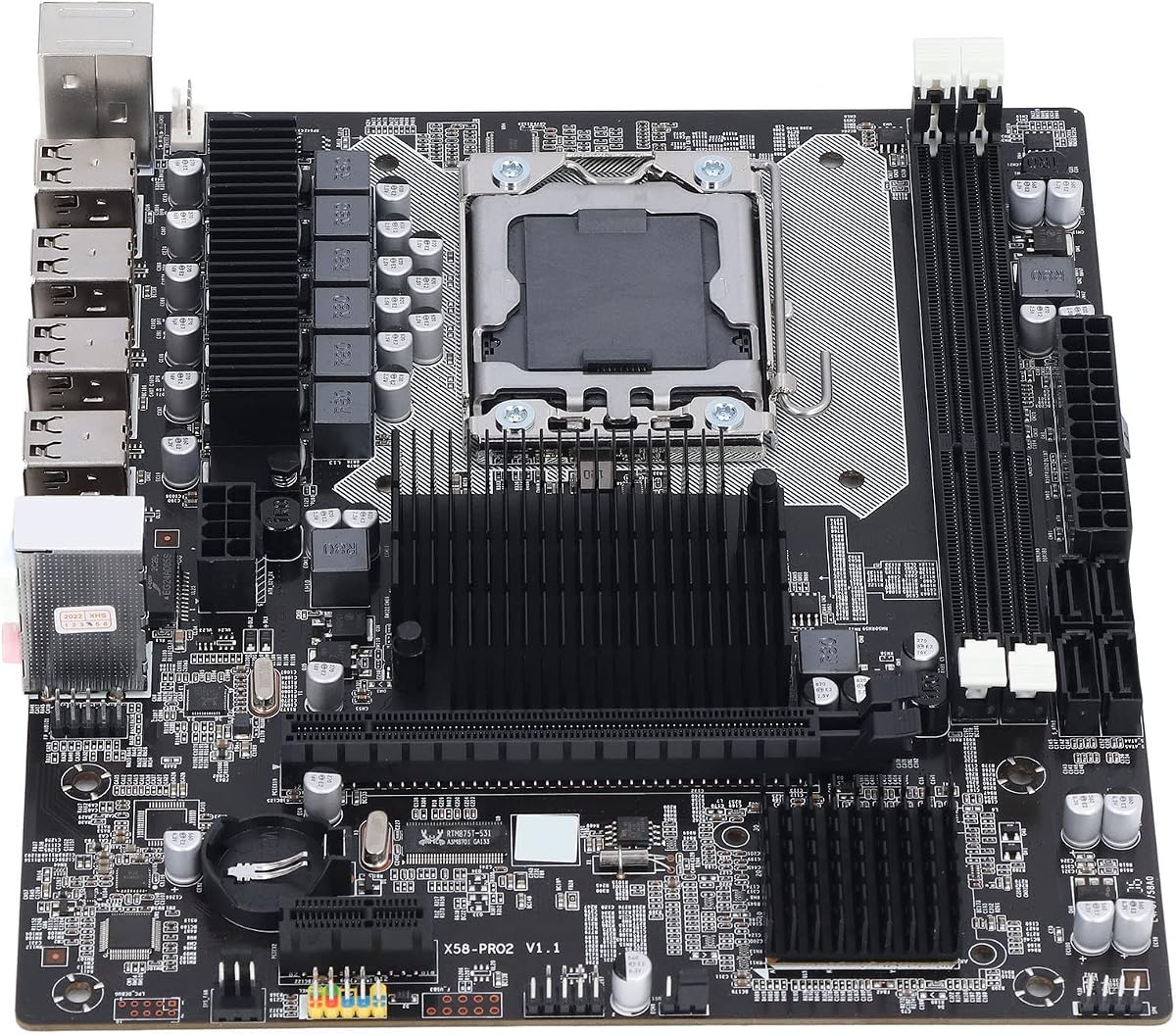
X58 Gaming Motherboard
ECC Memory Support
Solid Capacitors
Basic Connectivity
This guide compares the top ten Lga 1366 Motherboard models for enthusiasts, offering detailed specs, performance insights, and expert picks to help you build
Finding the right Lga 1366 Motherboard is crucial for enthusiasts maintaining or building legacy high-performance systems. These boards support powerful processors and offer unique features for specific workloads.
We evaluated ten distinct models based on chipset support, expansion capabilities, power delivery, and community reliability. Each entry reflects real-world usage patterns and technical specifications available.
This guide details top picks, full comparisons, and buying advice to match your needs. Prices vary widely and change frequently, so always verify current availability before purchasing any model.

5.0Editor score

4.7Editor score
The following table provides a side-by-side comparison of all ten models. It highlights key specifications to help you quickly identify which board meets your specific hardware requirements.



The ASUS P6T7 WS SuperComputer stands out as the top choice for professionals requiring maximum I/O and multi-GPU capabilities. Its perfect 5.0 rating reflects exceptional reliability and build quality.
We may earn a commission when you buy through this link, at no additional cost to you.
This board features two nVidia NF200 chips enabling 3-way SLI and CrossFireX simultaneously. It supports Core i7 Extreme and Xeon 3500 CPUs, making it ideal for heavy compute tasks.
While the price reflects its premium nature, the inclusion of 12 USB ports and dual LAN controllers justifies the cost. Users benefit from robust power delivery via the 24pin and 8pin connectors.
Buy this if you need a workstation board that handles professional rendering or data processing. It remains a benchmark for X58 chipsets even in current legacy environments.
The unique architecture supports up to three graphics cards for maximum parallel rendering performance.
Built with CEB form factor specifications, it offers stability closer to server-grade hardware than typical consumer boards.
We may earn a commission when you buy through this link, at no additional cost to you.
The X58 Gaming Motherboard offers the most affordable entry point into the Lga 1366 ecosystem. Its pricing makes it accessible for hobbyists or basic upgrades without breaking the bank.
We may earn a commission when you buy through this link, at no additional cost to you.
Despite the low cost, it includes all solid capacitors for stable power delivery. It supports both ECC and non-ECC memory, providing flexibility for various system configurations.
The board is designed with a straightforward setup using standard 8-pin and 24-pin connectors. While it lacks modern USB 3.0, it remains fully functional for older peripherals.
Choose this if budget is your primary constraint and you need a basic desktop upgrade. It suits simple gaming or workstation tasks where advanced connectivity is less critical.
Provides the essential X58 functionality needed to run legacy Core i7 processors at a minimal investment.
Focuses on core stability and power delivery rather than excessive connectivity or features for cost savings.
We may earn a commission when you buy through this link, at no additional cost to you.
The Supermicro X8STI brings server-grade reliability to the desktop Lga 1366 market. Its high 4.7 rating highlights consistent performance and robust manufacturing standards.
We may earn a commission when you buy through this link, at no additional cost to you.
It features two Intel 82574L Gigabit controllers for redundant or high-bandwidth networking. The X58 chipset supports QPI up to 6.4 GT/s, ensuring smooth CPU communication.
The inclusion of Matrox G200eW graphics provides stable basic video output without needing a dedicated GPU. This makes it ideal for systems that prioritize stability over visual flair.
Buy this if you require a system that runs 24/7 without crashes. Its premium build quality is perfect for small servers or critical workstation roles.
Dual LAN ports ensure that if one network link fails, the other remains active.
Engineered to withstand continuous operation cycles common in server or heavy workstation environments.
We may earn a commission when you buy through this link, at no additional cost to you.
The ASUS P6X58D Premium is a feature-rich board focusing on speed and thermal efficiency. It boasts USB 3.0 and SATA 6Gb/s support, bridging legacy CPUs with faster storage.
We may earn a commission when you buy through this link, at no additional cost to you.
Its 16+2 phase power design ensures stable power delivery for overclocking. The Stack Cool 3+ technology reduces heat dissipation effectively, keeping temperatures low without noise.
ASUS TurboV allows for real-time tuning of the processor frequencies. This makes it a favorite among enthusiasts who want to squeeze extra performance from their hardware.
Choose this if you value speed and thermal management on a standard ATX board. It balances traditional build quality with necessary modern interface upgrades.
The heat-pipe solution dissipates heat without fans, reducing noise significantly.
The robust power phases support extreme tuning without risking stability or voltage spikes.
We may earn a commission when you buy through this link, at no additional cost to you.
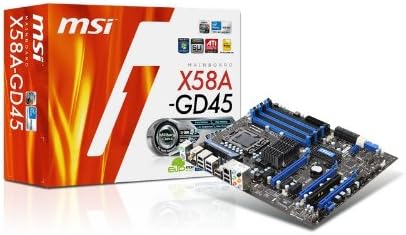
The MSI X58A-GD45 offers a balanced mix of expansion and speed. It supports three PCI Express x16 slots, allowing for significant GPU configurations.
We may earn a commission when you buy through this link, at no additional cost to you.
It features Revolutionary SuperSpeed USB 3.0 for faster data transfer rates compared to older standards. This is crucial for users with high-speed external drives.
Active Phase Switching (APS) dynamically controls power demand to reduce heat and energy consumption. This contributes to the board's noiseless and safe operation.
Buy this if you want a solid all-rounder without extreme workstation features. It is ideal for gamers who need robust expansion and modern connectivity.
The three PCIe slots allow for flexible multi-GPU setups or expansion cards.
Switching dynamically ensures power is only used when needed, extending component life.
We may earn a commission when you buy through this link, at no additional cost to you.
The ASUS P6X58D-E targets audio enthusiasts and expanders alike. It supports ATI Quad-GPU CrossFireX and nVidia 3-Way SLI for maximum graphical power.
We may earn a commission when you buy through this link, at no additional cost to you.
Its Realtek ALC889 8-Channel High Definition Audio CODEC delivers strong sound quality for multimedia tasks. The AI NET2 LAN controller ensures network integrity.
The board includes two SATA3 ports and two USB 3.0 ports for modern data speeds. This makes it versatile for hybrid storage setups combining old and new drives.
Select this if you need robust audio and GPU capabilities. It is a strong choice for media centers or heavy rendering workloads.
Supports up to four GPUs for extreme rendering tasks requiring massive parallel processing.
High definition audio codec provides rich sound for movies and music without external DACs.
We may earn a commission when you buy through this link, at no additional cost to you.
The Dx58So Extreme Series adheres to the classic X58 specifications. It supports Intel Core i7 Extreme and regular i7 processors for high performance.
We may earn a commission when you buy through this link, at no additional cost to you.
As an ATX board, it fits standard cases without modification. The triple-channel memory architecture provides significant bandwidth for demanding applications.
This board focuses on stability and compatibility with older standards. While it lacks modern USB ports, it serves as a reliable foundation for legacy upgrades.
Buy this if you prefer a classic design without unnecessary modern additions. It is suitable for simple builds needing basic CPU support.
Focuses on proven X58 architecture without adding potentially unstable modern integrations.
Supports triple-channel memory for faster data transfer rates to the CPU.
We may earn a commission when you buy through this link, at no additional cost to you.
The Supermicro X8DTN+ stands out with dual processor support for extreme multitasking. It supports Xeon 5600/5500 series with QPI up to 6.4 GT/s.
We may earn a commission when you buy through this link, at no additional cost to you.
With a maximum of 144GB of ECC Registered DIMM, it handles heavy memory loads. The 5520 chipset ensures robust handling of complex data tasks.
It includes dual Gigabit Ethernet for reliable server connectivity. The EATX size provides ample room for large cooling solutions and components.
Choose this for high-end server applications requiring dual cores and massive memory. It is ideal for virtualization or data storage systems.
Allows two CPUs to run simultaneously for maximum computational power and throughput.
Supports over 100GB of RAM for extreme virtualization or database applications.
We may earn a commission when you buy through this link, at no additional cost to you.
The ASUS P6T Deluxe V2 supports Intel Dynamic Speed Technology for optimized CPU performance. It fits standard ATX cases and includes six DIMM slots.
We may earn a commission when you buy through this link, at no additional cost to you.
It handles DDR3 memory speeds up to 1866MHz OC. This allows for efficient multitasking and high-performance applications on legacy hardware.
The chipset supports Intel Core i7 and Xeon CPUs with triple channel architecture. It is a versatile choice for general purpose computing tasks.
Buy this for standard builds needing reliable performance. It is suitable for enthusiasts who need balanced support without extreme features.
Intelligently adjusts CPU speed to match workload demands for efficiency.
Utilizes three memory channels to maximize bandwidth for the CPU.
We may earn a commission when you buy through this link, at no additional cost to you.
The Intel DX58SO Extreme Series provides a simple retail option. It supports up to 16 GB of DDR3 system memory and includes 12 USB ports.
We may earn a commission when you buy through this link, at no additional cost to you.
It features 7.1 Dolby Digital Audio for strong sound. The board supports SLI or CrossFireX for multi-GPU setups.
As a retail board, it offers essential overclocking utilities without complex enterprise features. It fits well for basic home or office use.
Buy this for a straightforward build with good audio. It is perfect for users needing simple connectivity without advanced customization.
7.1 surround audio support for immersive multimedia playback.
12 USB ports allow for extensive peripheral connectivity.
We may earn a commission when you buy through this link, at no additional cost to you.
Selecting the right motherboard involves matching your CPU, memory, and future needs. These factors ensure long term stability and performance.
Ensure the chipset is X58 or 5520. These support Lga 1366 CPUs like Core i7 and Xeon. Avoid incompatible boards that do not support your processor generation.
Verify the chipset model to avoid non-functional boards.
Check if the board supports ECC and Unbuffered memory. Some models support up to 24GB while others 144GB. Match this to your workload.
Confirm RAM capacity and channel architecture.
Look for PCIe x16 slots if you use multiple GPUs. Boards like the P6T7 WS offer extensive options. Others have minimal slots for simple builds.
Ensure enough slots for your planned hardware.
Stable power phases are vital for overclocking and longevity. Look for designs with solid capacitors and 24pin plus 8pin connectors. Weak power delivery risks system crashes.
Choose boards with robust power phases.
USB 3.0 and SATA 6Gb/s are useful for modern storage. Ethernet quality matters for networking. Some boards offer dual LAN for redundancy.
Select connectivity matching your peripherals.
Ensure the board fits your case. Most are ATX but some are CEB or EATX. Measure your case to avoid fit issues.
Match board size to your case size.
Server grade boards like Supermicro offer higher stability. Consumer boards may lack long term reliability. Consider the target use case.
Pick quality based on usage.
Check onboard audio codecs and graphics. Some boards include Matrox graphics or Dolby Audio. Ensure these meet your needs before buying a GPU.
Verify onboard features match your expectations.
Handle the motherboard by the edges to avoid static damage. Ensure you ground yourself before installation to protect sensitive components.
Install the CPU and RAM correctly using the notches. Do not force components as this can break pins or slots.
Update BIOS settings to enable overclocking or XMP. Monitor temperatures to ensure cooling solutions are effective.
These boards support Intel Core i7 900 series and Xeon 3500 series processors. Some support Xeon 5600 series. Always check CPU compatibility lists before buying.
Most Lga 1366 boards lack native NVMe slots. You may need a PCIe adapter card. Ensure your BIOS supports UEFI or legacy boot options.
Some boards like the X58 Gaming Motherboard and Supermicro X8STI support ECC memory. Others do not. Verify this specification if reliability is your priority.
Depends on the board. Standard models support up to 24GB. Dual CPU models like X8DTN+ support up to 144GB. Check the max capacity listed.
Not all boards include USB 3.0. Models like ASUS P6X58D Premium and MSI X58A-GD45 offer it. Others only support USB 2.0 for basic needs.
Yes especially models with multi GPU support like P6T7 WS. They offer stable power and PCIe slots for graphics cards. Ensure your CPU matches your game demands.
We reviewed ten models ranging from budget options to workstation powerhouses. The ASUS P6T7 WS SuperComputer stands out for professionals.
Prioritize power delivery and RAM slots based on your needs. Stability is key for legacy systems.
Prices and availability change fast. Always verify current stock and pricing before purchasing.